

Why Your Brand's Voice is Your Most Powerful Marketing Asset
In a saturated market, what you sell is often less important than how you say it. A brand voice is more than just words on a page; it's the consistent personality your business projects across every touchpoint, from social media captions to customer service emails. A well-defined voice builds trust, fosters connection, and can transform casual buyers into loyal advocates. This is the difference between a brand that simply exists and one that truly connects.
This article dissects 7 powerful brand voice examples, offering a strategic blueprint to help you find a voice that not only resonates but also drives growth. We will move beyond surface-level descriptions to analyze the specific tactics behind their success. You'll get actionable takeaways to apply to your own strategy, whether you're a startup defining your identity or an established enterprise refining your communication.
By exploring these case studies, you will learn how to:
- Identify the core components of a memorable brand voice.
- Align your tone with your target audience and business goals.
- Implement a consistent voice across all marketing channels.
Discover how to move beyond generic communication and cultivate a unique identity that stands out and speaks directly to your ideal customer.
1. Conversational and Friendly (Mailchimp)
A conversational and friendly brand voice is designed to feel approachable, warm, and human. It breaks down the traditional, formal barrier between a company and its customers, speaking to them as a knowledgeable and helpful friend would. This voice prioritizes clarity over jargon, empathy over corporate-speak, and connection over conversion. By using simple language, occasional humor, and a consistently supportive tone, brands like Mailchimp have turned potentially intimidating technical products into accessible tools for everyone.
The core of this approach is making complex subjects feel manageable. For instance, Mailchimp’s guides on email marketing use simple analogies to explain concepts like audience segmentation. Their error messages are another prime example; instead of a cold "Error 404," you might see a more empathetic, "Oops! It looks like something went wrong." This strategy is about building genuine trust and rapport with the audience.
The Strategy Behind the Friendliness
Why does this work so well? A friendly voice directly addresses the user's potential anxieties. For a small business owner venturing into email marketing for the first time, the process can be daunting. Mailchimp’s voice reassures them at every step, transforming a transactional relationship into a supportive partnership. This fosters incredible brand loyalty and makes users feel understood.
This approach is most effective for brands whose products or services might seem complex or are aimed at a non-expert audience. It's also powerful for companies that want to differentiate themselves in a crowded, formal market. By being the friendly, approachable option, a brand can carve out a memorable identity.
The infographic below summarizes the key features, benefits, and top brands associated with this conversational style.
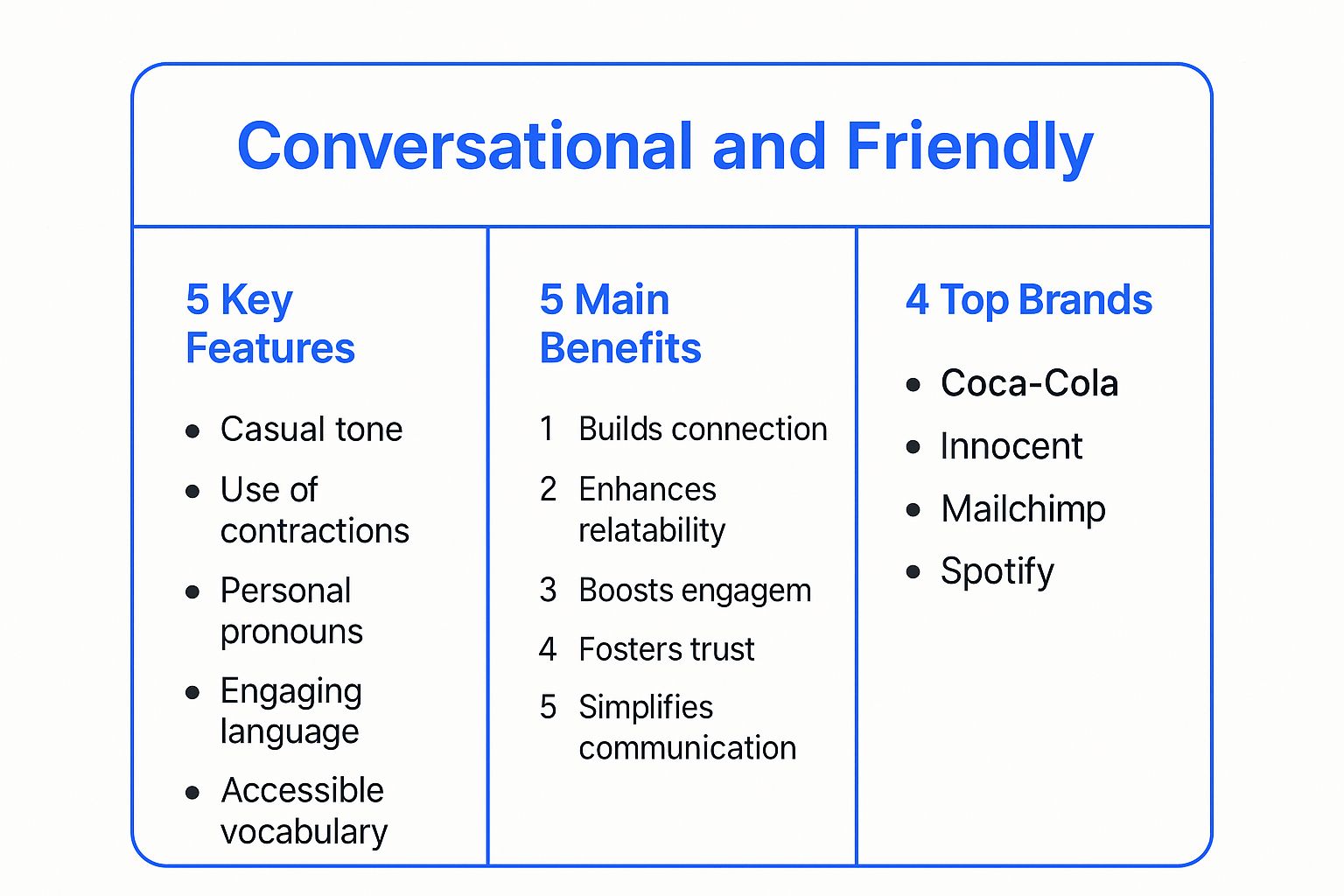
As the visualization highlights, the primary benefits of this voice are increased customer engagement, stronger brand loyalty, and a more humanized, relatable brand image.
Actionable Takeaways for Your Brand
To replicate this among your brand voice examples, start by defining your brand's personality as if it were a person. Are you a witty expert, a patient mentor, or a cheerful supporter?
- Create a Style Guide: Document your voice with specific "do's and don'ts." For example: "Do use contractions like 'you're' and 'we'll.' Don't use technical jargon without explaining it."
- Train Everyone: Consistency is crucial. Ensure every team member, from marketing to customer support, understands and applies the brand voice.
- Test and Refine: The level of "casual" can vary. Test different tones in your communications and use customer feedback and engagement metrics to find the sweet spot for your specific audience. To scale this, you can explore how to create better marketing content with AI writing tools to maintain consistency across all channels.
2. Bold and Irreverent (Cards Against Humanity)
A bold and irreverent brand voice deliberately breaks conventional rules, uses provocative humor, and often challenges social norms. This approach is designed to be memorable, polarizing, and deeply authentic, cutting through the noise by refusing to be bland or overly cautious. It speaks directly to an audience that values unfiltered honesty and a sense of rebellion over corporate polish. Brands like Cards Against Humanity use this voice to create an exclusive in-group of fans who "get the joke."
The essence of this voice is its unapologetic nature. It’s not just about being funny; it's about having a strong, often satirical, point of view. For instance, Cards Against Humanity’s Black Friday "pranks" have included selling nothing for $5 or literally digging a pointless hole, which serves as a sharp critique of consumerism. This isn’t just marketing; it’s a performance that reinforces their entire brand identity as smart, cynical, and unafraid to be disliked.
The Strategy Behind the Irreverence
Why embrace a voice that risks offending people? Because for the right audience, it creates an unbreakable bond. An irreverent voice signals that a brand isn't afraid to have a personality, making it stand out in saturated markets. For a product like Cards Against Humanity, a "party game for horrible people," a polite or friendly voice would be completely inauthentic and ineffective. The bold tone is a perfect match for the product itself.
This approach works best for brands targeting a niche audience that shares a specific worldview or sense of humor. It is highly effective for challenger brands aiming to disrupt an established, more conservative industry. By being intentionally provocative, a brand can generate significant organic buzz and build a fiercely loyal community that defends and champions its bold stances.
Actionable Takeaways for Your Brand
Adopting this voice is a high-risk, high-reward strategy that requires careful execution. It's not about being offensive for the sake of it, but about being true to a unique brand personality.
- Define Your Line: Know exactly how far you are willing to go. Your irreverence should be rooted in your brand’s core values, not random shock tactics. Document these boundaries clearly.
- Know Your Audience Intimately: This voice is not for everyone. You must have deep confidence that your target audience will appreciate the humor and not be alienated by it. Conduct thorough audience research.
- Prepare for Backlash: A bold voice will inevitably attract criticism. Have a plan for how your brand will respond (or not respond) to negative feedback. Standing firmly behind your statements is key to maintaining authenticity.
3. Professional and Authoritative (McKinsey & Company)
A professional and authoritative brand voice is built on a foundation of expertise, credibility, and industry leadership. This voice communicates with confidence and precision, using data-driven insights, formal language, and specialized terminology to establish the brand as a definitive source of knowledge. It doesn't aim to be a friend; it aims to be the foremost expert in the room. Brands like McKinsey & Company master this voice, positioning themselves as trusted advisors for complex, high-stakes decisions.
The core of this approach is demonstrating irrefutable expertise. Instead of simplifying concepts, this voice dives deep, assuming a sophisticated audience that values detail and evidence. For example, McKinsey's extensive reports on global economic trends are filled with proprietary data, complex charts, and nuanced analysis. Their language is formal and direct, avoiding casualisms to maintain a tone of serious, intellectual rigor. This strategy is about building trust not through friendliness, but through proven competence and unparalleled insight.
The Strategy Behind the Authority
Why is this voice so effective? An authoritative tone directly appeals to audiences seeking solutions to critical, complex problems. For a C-suite executive navigating industry disruption, a friendly suggestion isn't enough; they need a definitive, evidence-backed strategy from a proven leader. McKinsey's voice provides that assurance, transforming a client relationship into a strategic alliance built on respect for their intellectual capital. This fosters deep-seated trust among high-level decision-makers.
This approach is most powerful for B2B brands, consulting firms, financial institutions, and technology companies operating in intricate or heavily regulated fields. It’s essential for any organization whose primary value proposition is its knowledge and expertise. By being the most credible and insightful voice, a brand can dominate its niche and command premium value for its services.
Actionable Takeaways for Your Brand
To cultivate an authoritative voice, focus on showcasing substance and expertise with unwavering consistency. Your brand should embody the persona of a seasoned, respected industry leader.
- Prioritize Data Over Opinion: Every major claim must be backed by solid evidence. Use original research, comprehensive data analysis, and expert citations to build your arguments.
- Develop a Content Framework: Create a strategy that positions your team as thought leaders. This includes producing in-depth white papers, detailed case studies, and insightful analysis of industry trends. For new ventures, a solid content marketing for startups guide can help structure this effort from the ground up.
- Maintain Linguistic Precision: Create a style guide that mandates formal language. For instance: "Do use precise, industry-specific terminology. Don't use contractions, slang, or overly emotional language." This ensures every communication, from a report to an email, reinforces your authority.
4. Inspirational and Empowering (Nike)
An inspirational and empowering brand voice is built to motivate action, celebrate achievement, and push audiences beyond their perceived limits. It moves beyond just selling a product and instead sells a vision of personal transformation and success. This voice uses powerful, emotive language, compelling narratives, and aspirational imagery to connect with the customer's deepest goals and ambitions. By aligning the brand with these powerful feelings, companies like Nike make their products feel like essential tools for achieving greatness.
This approach is about creating an emotional bond by tapping into universal human desires for growth, strength, and victory. Nike’s iconic “Just Do It” slogan isn’t just a tagline; it's a direct command and a call to action that frames every challenge as surmountable. Their storytelling, which often features athletes overcoming incredible odds, reinforces the idea that the audience, too, possesses this inner strength. The product becomes secondary to the feeling of empowerment it enables.

The Strategy Behind the Inspiration
So, why is this one of the most powerful brand voice examples? An empowering voice forges a deeply loyal community. When a brand successfully positions itself as a partner in a customer's personal journey, the relationship transcends commerce. Customers don't just buy a product; they buy into an ideology and become advocates for the brand that inspires them. This creates immense brand equity and long-term loyalty.
This voice is most effective for brands in the fitness, wellness, education, and self-improvement sectors. It’s ideal for any company whose product or service helps people become a better version of themselves. The key is to genuinely connect the brand's purpose with the customer's aspirations, making the messaging feel authentic rather than opportunistic.
Actionable Takeaways for Your Brand
To build an inspirational voice, you must first understand what truly motivates your target audience. What are their biggest dreams and their most significant obstacles?
- Focus on the "Why": Shift your messaging from what your product does to why it matters. Connect its features to higher-level benefits like confidence, achievement, and perseverance.
- Leverage User Stories: Showcase real customer successes. Testimonials and user-generated content are powerful tools for demonstrating that the empowerment you promise is real and attainable.
- Use Strong, Active Language: Employ verbs and declarative statements that inspire action. Use words like "conquer," "achieve," "transform," and "unleash" to evoke a sense of power and potential.
- Maintain Authenticity: The line between inspiration and cliché is thin. Ensure your motivational messages are grounded in genuine stories and reflect your brand's core values to avoid sounding hollow.
5. Quirky and Playful (Ben & Jerry's)
A quirky and playful brand voice is built on a foundation of fun, creativity, and unconventional communication. This voice uses witty wordplay, clever humor, and whimsical language to craft memorable and delightful customer experiences. Instead of standard corporate messaging, it leans into its personality, creating a distinct and entertaining identity. Brands like Ben & Jerry's master this by infusing playfulness into every aspect of their presence, from product names to social media posts.
This approach is about more than just being funny; it's a strategic choice to connect with an audience that values authenticity and personality over polish. Ben & Jerry’s flavor names, such as 'Phish Food' and 'Chunky Monkey', are perfect examples. They are not just descriptive but are small, joyful stories in themselves. This voice turns mundane interactions into opportunities for brand reinforcement and customer delight, making the brand feel more like an eccentric, fun-loving friend.

The Strategy Behind the Playfulness
Why does this voice resonate so strongly? A playful tone creates an emotional connection by generating positive feelings like amusement and surprise. For Ben & Jerry's, this aligns perfectly with their product-ice cream-which is inherently linked to happiness and indulgence. The quirkiness makes the brand unforgettable and highly shareable, turning customers into organic marketers who eagerly discuss the latest funny flavor name or social media campaign.
This voice is most effective for brands targeting a younger demographic or those in creative, lifestyle, or food and beverage industries. It’s a powerful way to stand out in a saturated market and build a community around shared values and a sense of humor. However, it requires a deep understanding of the audience to ensure the humor lands correctly and doesn't alienate potential customers.
Actionable Takeaways for Your Brand
To develop a quirky and playful voice, you need to infuse creativity into your communication framework while maintaining brand consistency.
- Establish Your "Playground Rules": Define the boundaries of your humor. What topics are fair game, and which are off-limits? For example: "Do use pop culture references and puns. Don't make jokes at the expense of customers or sensitive social issues."
- Empower Creative Copywriting: Encourage your team to experiment with wordplay and clever phrasing. A great brand voice example is a social media post that goes beyond a simple product announcement and tells a tiny, amusing story.
- Know When to Be Serious: A playful voice is a tool, not a constant mandate. Train your team to recognize situations, like serious customer complaints or company announcements, where a more straightforward and empathetic tone is required. Consistency doesn't mean being one-dimensional.
6. Minimalist and Direct (Apple)
A minimalist and direct brand voice prioritizes clarity, simplicity, and precision over elaborate language. This approach strips away unnecessary words, focusing only on essential messages to create sophisticated communication that respects the audience's time and intelligence. It conveys confidence and authority by letting the product and its benefits speak for themselves, without the need for fluff or persuasion. Brands like Apple have mastered this, using clean, impactful statements that feel both premium and incredibly clear.
The core of this voice is its "less is more" philosophy. Instead of lengthy descriptions, it uses short, powerful phrases. Consider Apple's marketing for the iPhone: "The ultimate iPhone." or "A total powerhouse." These statements are bold, direct, and leave a lasting impression. This voice doesn't just apply to marketing copy; it extends to user interfaces, product names, and even customer support interactions, creating a seamless and uncluttered brand experience.
The Strategy Behind the Simplicity
Why is this direct approach so powerful? A minimalist voice communicates supreme confidence and sophistication. By eliminating jargon and superfluous adjectives, the brand implies that the product’s value is self-evident. This builds a perception of high quality and innovation, positioning the brand as a leader rather than a follower. It appeals to a modern consumer who is often overwhelmed by information and appreciates brands that get straight to the point.
This voice is most effective for brands that offer premium, innovative, or design-focused products. It works well in technology, luxury goods, and modern design sectors where the quality of the product is the main selling point. By adopting a direct and uncluttered voice, a brand can cut through the noise of a saturated market and establish itself as an elegant, authoritative, and trustworthy choice, making it one of the most effective brand voice examples for premium positioning.
Actionable Takeaways for Your Brand
To develop a minimalist and direct voice, your brand must commit to a philosophy of radical simplicity and clarity in every piece of communication.
- Focus on a Single Core Message: For every communication, from an ad to a social media post, identify the one most important thing you want your audience to know. Build your entire message around that single, powerful idea.
- Use Strong, Active Language: Eliminate passive voice and weak verbs. Use concise, impactful language that drives the message home. Instead of "Our new software was designed to help you be more productive," try "Be more productive."
- Ensure Visual and Textual Harmony: Minimalist text must be supported by clean, high-quality visuals. The design should complement the directness of the copy, not compete with it. A key area to apply this is in your product descriptions, and you can learn how to write product descriptions that convert by embracing this focused approach.
7. Helpful and Educational (HubSpot)
A helpful and educational brand voice positions the company as a trusted, authoritative resource. It prioritizes providing immense value and solving customer problems over direct selling. This approach is built on a foundation of generosity, where the brand offers comprehensive guides, tutorials, data-driven reports, and practical advice freely. By educating their audience, brands like HubSpot build a deep, lasting relationship based on expertise and trust, turning readers into loyal customers over time.
The core principle is to empower the user. Instead of just highlighting product features, this voice explains the why and how behind the industry’s best practices. HubSpot’s blog, for example, is a masterclass in this, offering exhaustive articles on everything from social media marketing to sales funnel optimization. They answer the questions their target audience is already asking, establishing themselves as the go-to source for reliable information long before a purchase is ever considered. This makes their brand synonymous with industry knowledge.
The Strategy Behind the Education
Why is this one of the most effective brand voice examples? An educational voice builds an audience, not just a customer list. By consistently delivering high-quality, valuable content, a brand attracts potential users who are actively seeking solutions. This inbound marketing approach, pioneered by HubSpot, creates a powerful flywheel effect: the more helpful content you produce, the more traffic and leads you generate, which in turn fuels more growth.
This strategy is exceptionally effective for B2B companies, SaaS products, and brands in complex or rapidly changing industries like tech, finance, or marketing. It works because it addresses the buyer’s need for information and confidence before they commit to a solution. By becoming the teacher, you become the first and most trusted option when it's time to buy.
Actionable Takeaways for Your Brand
To develop a helpful and educational voice, focus on becoming the most valuable resource in your niche. Your goal is to teach, guide, and support your audience at every stage of their journey.
- Identify Pain Points: Use keyword research and customer feedback to discover your audience's biggest challenges and questions. Create content that directly answers them.
- Create Pillar Content: Develop comprehensive, in-depth resources like ultimate guides, e-books, and free courses that cover a topic exhaustively. This establishes authority and becomes a long-term asset.
- Be Practical and Data-Driven: Ground your advice in real-world examples, statistics, and step-by-step instructions. For instance, when explaining a concept, provide clear guidance on its application, much like you would when you learn how to write product descriptions using AI.
Brand Voice Style Comparison of 7 Examples
| Brand Voice | 🔄 Implementation Complexity | 💡 Resource Requirements | 📊 Expected Outcomes | 🎯 Ideal Use Cases | ⭐ Key Advantages |
|---|---|---|---|---|---|
| Conversational and Friendly (Mailchimp) | Moderate – requires careful tone balance and consistency | Moderate – style guides and team training needed | Strong emotional connection and increased loyalty | Technology, SaaS, Consumer goods, Food & beverage | Builds trust and relatability, lowers engagement barriers |
| Bold and Irreverent (Cards Against Humanity) | High – risky approach needing legal review and audience insight | High – ongoing monitoring and careful messaging | High brand recognition, viral word-of-mouth marketing | Entertainment, Consumer products, Lifestyle, Gaming | Creates loyal, passionate following; stands out clearly |
| Professional and Authoritative (McKinsey & Company) | Moderate to High – requires expert knowledge and data-backed content | High – expert content creation and industry research | Strong credibility and market leadership | Consulting, Financial services, B2B technology, Legal | Commands premium pricing and trust in decision-makers |
| Inspirational and Empowering (Nike) | Moderate – consistent authentic storytelling required | Moderate to High – content creation with real stories | Emotional motivation and aspirational brand image | Sports, Personal development, Beauty, Education | Drives customer action and passionate advocacy |
| Quirky and Playful (Ben & Jerry's) | Moderate – creative consistency and humor management required | Moderate – creative teams and ongoing ideation | Memorable brand experiences and social media engagement | Food & beverage, Consumer products, Entertainment | Differentiates brand through creativity and fun |
| Minimalist and Direct (Apple) | Low to Moderate – emphasizes simplicity and clarity | Moderate – focus on concise messaging and design alignment | Clear understanding and premium perception | Technology, Luxury goods, Design, Premium services | Sophisticated, easy-to-understand messaging |
| Helpful and Educational (HubSpot) | High – requires sustained expertise and comprehensive content | High – ongoing research, content creation, and updates | Long-term trust and lead generation | SaaS, B2B services, Education, Professional tools | Positions brand as trusted authority and resource |
Finding Your Voice: From Inspiration to Implementation
We've explored a diverse spectrum of powerful brand voice examples, moving from the bold irreverence of Cards Against Humanity to the authoritative precision of McKinsey & Company. Each case study, whether it's the friendly reassurance of Mailchimp or the minimalist confidence of Apple, serves as a powerful testament to a fundamental truth: a well-defined brand voice is not a "nice-to-have" marketing asset. It is the core of your brand's identity, the engine of customer connection, and a critical driver of loyalty and trust.
These examples reveal that the most successful voices are never accidental. They are the result of deliberate, strategic choices that reflect a deep understanding of the brand's core values, its audience's communication style, and its unique position in the marketplace. Nike's empowering tone isn't just motivational; it’s a strategic decision to align with the mindset of athletes and aspiring individuals. Similarly, HubSpot's helpful and educational voice is a calculated approach designed to build authority and establish trust with businesses seeking growth.
Synthesizing Inspiration into Action
The journey from analyzing these examples to implementing your own unique voice can feel daunting, but it follows a clear, actionable path. Your primary task is to distill the lessons learned and apply them systematically to your own brand context.
- Define Your Core Identity: Go beyond simple adjectives. Ask critical questions. Are you a mentor (like HubSpot), a challenger (like Cards Against Humanity), or an innovator (like Apple)? Document three to five core personality traits that will serve as your North Star.
- Audit Your Audience: Analyze how your target customers communicate. What language do they use on social media? What tone resonates in the communities they belong to? Your voice must meet them where they are to build a genuine connection.
- Map Your Competitive Landscape: How do your competitors sound? Identifying their vocal patterns reveals opportunities. You can either align with an established industry tone or, more powerfully, carve out a distinct space by adopting a contrasting voice.
Codifying Your Voice for Consistency
Once you have established your brand's personality, the next critical step is creating a comprehensive style guide. This document is the single source of truth that ensures everyone, from marketing interns to senior executives, communicates with a unified voice. It translates abstract personality traits into concrete communication rules.
Your style guide should be a living document, but its initial version must include:
- Tone & Attitude: Detail the specific tones to use in various scenarios (e.g., celebratory for a product launch, empathetic for a customer support issue).
- Vocabulary & Phrasing: List "words we use" and "words we avoid." Should you use contractions? Is industry jargon acceptable or forbidden?
- Grammar & Punctuation: Settle debates before they start. Specify your stance on things like the Oxford comma or capitalization in headlines.
Mastering your brand voice is the ultimate strategic advantage. It transforms your company from a faceless entity into a memorable personality, fostering relationships that transcend mere transactions. By moving from inspiration to intentional implementation, you build a consistent and authentic presence that resonates deeply with your audience, ensuring every word you publish reinforces who you are.
Ready to build and maintain a consistent brand voice with unparalleled efficiency? Stravo AI’s Brand Voice feature allows you to embed your style guide directly into the AI, ensuring every piece of content perfectly matches your unique tone. Stop policing content and start creating with confidence by visiting Stravo AI to see how it works.
Article created using Outrank