
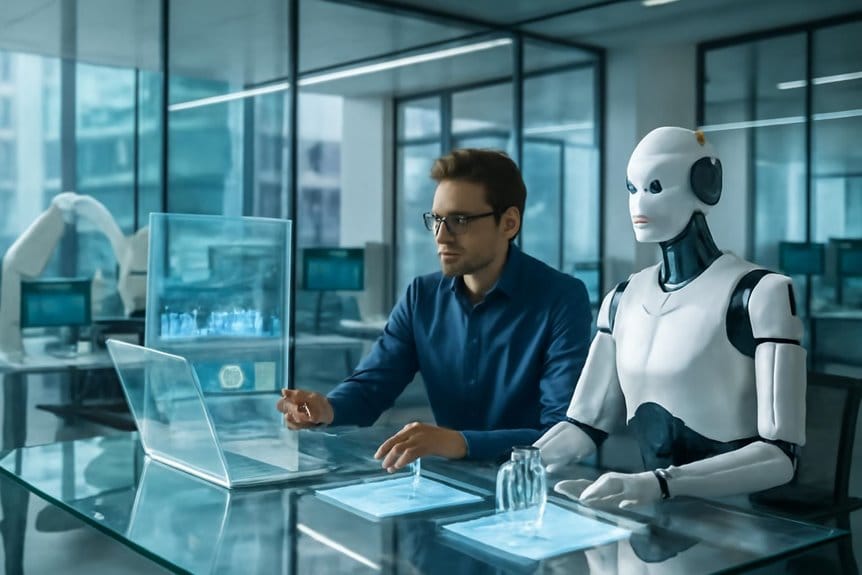
AI will transform work by automating routine tasks and amplifying human judgment. Employees will shift from execution to oversight, synthesis, and decision framing. Productivity will rise as tools handle data, scheduling, and basic analysis. Roles will evolve toward creativity, governance, and quality control. Organizations must invest in reskilling, data literacy, and continuous learning. Leadership will emphasize ethical governance and change management. Continue for practical steps and strategies to prepare teams and systems for this shift.
Key Takeaways
- AI will automate routine, repetitive tasks, freeing workers to focus on higher-value, creative, and supervisory work.
- Job roles will evolve into hybrid human–AI partnerships emphasizing oversight, decision framing, and quality control.
- Organizations will require widespread reskilling in AI, data literacy, and soft skills like critical thinking and adaptability.
- Embedded AI in tools will boost productivity, automate workflows, and reduce time spent on document and customer-service tasks.
- Responsible governance, continuous monitoring, and transparent change management will be essential to manage risks and ensure equitable adoption.
Key AI Technologies Transforming the Workplace
How are workplaces being transformed by AI technologies? Organizations adopt generative AI and large language models powered by machine learning to create content, automate workflows, and enable natural language interaction. Embedded AI tools in suites streamline scheduling, document drafting, and decision support, yielding productivity boosts. Autonomous AI systems execute multistep tasks with minimal oversight, leveraging external data, memory, and continuous improvement. AI applications extend across healthcare monitoring, customer service, and recruitment, reshaping established processes. AI integration requires prompt engineering and rising technical literacy across roles. Consequently, emphasis shifts to skills development so staff can manage, evaluate, and collaborate with advanced systems while governance and role redesign guide responsible deployment. Organizations must invest in training, change management, and clear oversight frameworks for effective adoption. Additionally, tools like the DeepAI Text Generator provide quick content solutions, enhancing efficiency and creativity in content creation tasks.
How AI Increases Task Productivity
When routine tasks such as data entry and basic analysis are automated by AI, overall task productivity rises markedly. AI-driven tools accelerate document processing and customer inquiries, boosting workflow efficiency and reducing time on repetitive duties. Studies report productivity gains up to 30% after AI integration. Personalized AI training supports workforce adaptation, shortening onboarding and improving task completion speed. Automation shifts focus to higher-value activities without detailing role changes. A well-defined voice helps teams communicate with a unified tone, reinforcing brand identity and supporting the creation of a memorable and authentic brand presence.
| Area | Impact |
|---|---|
| Document processing | Faster throughput, fewer errors |
| Customer service | Quicker responses, standardized replies |
This concise evidence shows AI enhances task productivity through targeted automation and support for staff adaptation. Measured gains prompt managers to prioritize AI-driven tools and personalized training, creating measurable efficiency improvements while maintaining operational quality and employee engagement over time consistently.
Transforming Workflows and Job Roles
Why are workflows changing so rapidly? Organizations deploy AI to automate routine tasks such as data entry and basic analysis, driving workflow efficiency and reshaping job roles.
Workflows are modularized: tasks are decomposed and task allocation assigns repetitive components to machines while humans focus on curation, review and guiding AI outputs.
AI-driven tools enable workplace transformation across recruitment, healthcare monitoring and customer service automation, blending automation with human-AI collaboration to boost productivity.
The integration of generative and autonomous systems transforms traditional functions, prompting a shift in responsibilities toward oversight, quality control and decision framing.
This redistribution reduces cycle times and error rates while redefining accountability, coordination and the boundaries between human judgment and machine execution in organizational processes, enabling continuous operational improvement globally.
Incorporating AI into workflows also facilitates strategic keyword integration to improve SEO, ensuring content remains relevant and accessible.
Skills and Workforce Development for the AI Era
A rapid reconfiguration of required competencies is underway as up to 70% of workplace skills are expected to change by 2030, driving a shift away from routine tasks like data entry toward higher-order capabilities. Organizations prioritize workforce development to sustain workforce competitiveness, investing in personalized AI training that builds AI skills, data literacy and domain knowledge. Emphasis on soft skills—critical thinking, emotional intelligence and adaptability—complements technical proficiency. Workers face continuous learning pathways to fill emerging roles created by automation and AI augmentation. Practical steps include:
- Reskilling programs focused on AI skills and data literacy.
- Microcredentials and on-the-job AI training for emerging roles.
- Assessment-driven continuous learning to measure adaptability and future of work readiness.
Policy alignment supports equitable access to nationwide reskilling. Additionally, content optimization and performance measurement are crucial in ensuring that training materials are effectively reaching and engaging with the workforce.
Leadership, Culture, and Change Management
How can leaders align strategy, people, and processes to make AI adoption sustainable? Effective leadership frames AI adoption around clear organizational goals, integrating change management with workforce upskilling and a roadmap for ongoing technological change. Culture must shift toward openness and adaptability, encouraging experimentation while maintaining ethical standards. Clear communication of AI’s purpose, transparent data governance, and defined accountability build trust. Practical change management addresses employee concerns, supports continuous learning, and measures progress against strategic milestones. Investing in training aligns skills with tasks transformed by AI without losing sight of mission. Leaders can leverage AI tools to automate research, trend analysis, and data summarization, thereby enhancing strategic decision-making and operational efficiency. Sustained success depends on leadership that models agility, reinforces values, and institutionalizes mechanisms for feedback, ensuring AI initiatives remain aligned with evolving organizational goals. Leaders must prioritize resource allocation and governance now proactively.
Economic and Labor Market Impacts of AI
The labor market is entering rapid restructuring as AI-driven automation could replace up to 30% of US work hours by 2030 and is linked to the displacement of roughly 85 million jobs globally by 2025. Observers note concurrent job creation—up to 97 million new roles—and an estimated $13 trillion economic impact by 2030. Routine tasks like data entry and basic analysis will shrink, shifting demand toward different workforce skills. Policymakers and employers face simultaneous challenges of job displacement and job creation during AI integration. Content goals and audience play a crucial role in guiding strategy and measuring outcomes in this evolving landscape. Reskilling: ~70% of workforce skills will change, requiring targeted training. Sectoral shifts: Automation reshapes industries unevenly. Productivity gains: AI boosts growth while altering labor composition. Net outcomes depend on policy, education, and firm-level AI adoption choices broadly.
Preparing for a Hybrid Human–AI Workplace
While roughly 70% of workforce skills are expected to change over the next five years, organizations must proactively design change-management and reskilling strategies that pair clear communication with personalized AI-driven training and ongoing employee support. Preparing for a hybrid workplace requires reskilling and upskilling pathways, AI integration plans, and measurable change management to enable workforce adaptation. Personalized employee training fosters human-AI collaboration and preserves roles emphasizing critical evaluation and contextual understanding. Organizational culture must reward continuous learning and reassess job design as automation increases. Long-term success depends on iterative assessment, transparent governance, and aligning AI initiatives with strategic goals. Leaders should monitor outcomes, invest in employee training, and embed continuous learning into organizational culture systematically. Moreover, organizations can benefit from leveraging advanced natural language processing capabilities to enhance communication and content creation, enabling a more efficient and adaptable workforce.