
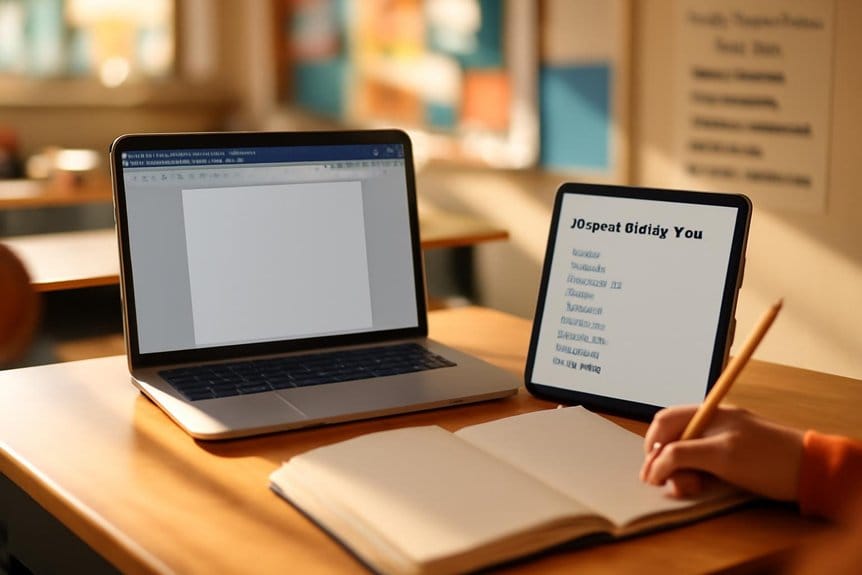
The best free AI writers for students support outlining, drafting, and revision while discouraging academic dishonesty through clear attribution, citation help, and privacy safeguards. Beginner-friendly options like Raptor Write and ChatGPT work well for outlines and first drafts, while Grammarly, SMMRY, and Scholarcy help with editing, note-taking, and summaries. Ethical use means treating AI output as a draft, verifying facts and citations, and rewriting in a personal voice. The sections ahead explain a simple, reliable workflow.
Key Takeaways
- Choose a free, student-friendly AI writer like Raptor Write or ChatGPT for outlines, brainstorming, and first drafts—not final submissions.
- Prefer tools that promote transparency, label AI-generated text, and encourage attribution and citation help to support academic integrity.
- Use AI ethically by revising heavily, adding your own reasoning and examples, and disclosing AI assistance per course policy.
- Verify facts and citations yourself; AI can invent sources, authors, or page numbers, so cross-check with library databases and originals.
- Protect privacy by reviewing data policies, minimizing sensitive inputs, and using tools that offer user control over stored prompts.
What Makes a Free AI Writer Ethical for Students?
An ethical free AI writer for students is defined less by its ability to generate polished text than by how it supports learning without enabling academic dishonesty. It should reinforce research, drafting, and revision skills, not replace original thinking or encourage copy‑paste submission. AI transparency matters: the tool must clearly label AI-generated passages, explain limitations, and discourage presenting outputs as solely student work. Responsible features include citation assistance, paraphrasing support that preserves meaning, and prompts for proper attribution. Data privacy is equally central; policies should minimize collection, avoid selling or sharing student information, and provide clear controls for deletion and retention. Finally, usage guidelines should frame the system as an aid for understanding and iteration, aligned with classroom expectations and integrity policies. Integrating AI-powered tools for grammar and style checks can ensure content consistency while still maintaining the student’s unique voice and perspective.
The Best Free AI Writing Tools for Students (By Category)
Which free AI writing tools actually help students without adding cost or complexity? In the “no-budget, beginner-friendly” category, Raptor Write stands out as a completely free option built for students with basic needs. Its simple interface reduces setup friction, while the included free course helps first-time users learn how to prompt, revise, and check results responsibly. Raptor Write is best positioned as an entry-level assistant for early or small-scale writing projects where essential support matters more than advanced automation. Compared with paid tools, it lacks premium features, but that limitation can reinforce Ethical Boundaries by encouraging students to do the substantive thinking themselves. It also supports Creative Collaboration by letting students iterate drafts and language choices without committing money or adopting a complex workflow. Additionally, users should be aware of AI ethics and potential biases when utilizing these tools.
Best Free AI Writer by Task: Essays, Notes, and Summaries
For students choosing a free AI writer, the best option depends on the task: essay drafting versus note-taking and summarization. Tools such as Raptor Write and ChatGPT can generate essay outlines and first drafts quickly, while Grammarly’s free generator supports concise notes and clean summaries through editing and refinement. Additionally, using tools like Word Spinner can help ensure content authenticity by humanizing and rewriting text for a natural tone, which is crucial in academic settings. The sections below compare the strongest free picks for essay writing and for producing organized notes and summaries, alongside ethical use expectations.
Best Free Essay Writers
How can students get reliable help with essays, notes, and summaries without paying for premium tools? Raptor Write stands out as a free, entry-level option for drafting essays when budgets are tight. Its simple interface and minimal feature set make it easy for beginners to start quickly, generating essay outlines, brief summaries of source material, and rough first drafts at no cost.
However, it should be treated as a starting point rather than a final-writing solution: customization is limited, and it lacks advanced capabilities such as citation generation or fine-grained style editing. Students should also evaluate AI bias in outputs and make careful choices about data privacy, avoiding sensitive personal information.
Used transparently, it supports ethical, affordable writing practice and revision.
Free Note And Summary Tools
When study time is limited, free AI note and summary tools can compress long readings and lecture material into clear, reviewable points. Notion AI and Obsidian can auto-summarize lengthy text, while ChatGPT’s free tier produces concise notes from articles or lecture transcripts with minimal prompts. SMMRY and Scholarcy also condense papers and textbook chapters into key ideas, often with multilingual support and outlining features. Effective use depends on ethical habits, AI customization, and data privacy awareness.
- Use summaries to preview, then read the source for accuracy.
- Keep original notes to show understanding and protect integrity.
- Customize prompts and templates to match course goals.
- Avoid uploading sensitive documents; review each tool’s policies.
How to Use Free AI Writing Tools Without Plagiarizing
Why do free AI writing tools feel like a shortcut, yet pose real plagiarism risks? Because they can generate polished passages that tempt students to paste them verbatim, even when outputs echo training data or reflect AI bias. Students should treat AI text as a draft source, not a final submission, and follow campus rules for disclosure and citation. When AI contributes wording or structure, it should be acknowledged like any other assistance to protect academic integrity. Paraphrasing tools can help reshape phrasing into an authentic voice, but students must add their own reasoning, evidence, and conclusions. To ensure that their work remains genuine, students can use content rewriting tools to humanize automated content, avoiding AI detection and plagiarism. To reduce penalties, they can run AI detectors to check whether a submission is flagged. Finally, students should consider data privacy, avoiding sensitive prompts and saving drafts securely.
Copy-Paste Prompts That Improve Your Writing (Ethically)
Often, the difference between ethical help and academic misconduct comes down to the prompt a student copies and pastes. The safest prompts ask for scaffolding, feedback, and options, then require the student to verify facts, add sources, and rewrite in a personal voice. This approach supports AI personalization while staying within ethical AI guidelines and academic integrity rules. Use these copy-paste prompts to strengthen skills without outsourcing learning:
- “Create a thesis and outline from my notes; leave gaps for evidence I will add.”
- “Suggest three counterarguments and questions I should research, with keywords.”
- “Rewrite this paragraph in a clearer style; keep meaning, highlight changes, and flag citations needed.”
- “Evaluate my draft for logic and clarity; propose revisions, but do not add new facts.”
Incorporating AI tools like ChatGPT can help students generate new content ideas and enhance storytelling while maintaining ethical standards.
AI Writing Mistakes That Get Students Flagged (and Fixes)
Students are most often flagged when AI is treated as a substitute for their own thinking, producing writing that shifts in tone, logic, or originality. Another common trigger is weak attribution: AI-assisted passages that omit citations, include invented sources, or misstate facts can violate academic integrity rules and fail review checks. The fixes center on using AI as a drafting aid, verifying claims against reliable references, and clearly citing or acknowledging any AI-supported contributions in line with institutional policy. Additionally, integrating blog content with email marketing allows for personalized, targeted campaigns that guide students in effectively using AI tools.
Overreliance On AI
How quickly can an essay drift into risky territory when AI becomes the primary author? Overreliance invites AI dependency and accelerates skill erosion, leaving a paper polished but hollow. When drafts mirror generic patterns, instructors may suspect undisclosed assistance, especially under strict institutional policies. Even without intent, copy‑pasting AI output can blur authorship and trigger plagiarism or misconduct reviews.
The safest approach is to treat AI as a brainstorming and editing aid, then rewrite with original reasoning, structure, and voice.
- Draft key claims independently before prompting.
- Use AI for outlines or clarity, not full paragraphs.
- Heavily revise: add course concepts, examples, and personal synthesis.
- Disclose AI use when required and follow local rules.
Citation And Fact Errors
Where a draft can unravel fastest is in its references: AI writing tools routinely produce credible‑looking citations and “facts” that are incomplete, outdated, misinterpreted, or entirely fabricated. That creates academic integrity risk when a student submits invented sources, misquotes research, or repeats misinformation as evidence.
Common citation errors include missing page numbers, wrong author names, incorrect publication dates, or formatting that fails APA/MLA requirements, all of which must be corrected manually to reach citation accuracy.
Fact errors often stem from model guesswork or stale training data, so fact verification is essential. Effective fixes include cross‑checking every claim against primary or authoritative sources, using library databases, and running dedicated fact‑checking tools.
Any unsupported statement should be revised, cited properly, or removed.
A Simple Ethical AI Workflow for School (5 Steps)
Why risk academic integrity when a simple, ethical workflow can guide AI use from start to finish? A five-step routine helps students apply AI ethics while protecting student privacy and meeting school expectations. Free tools such as Grammarly’s AI Writer or Raptor Write can support drafting, but only within clear boundaries and with transparent citation practices.
- Clarify policy and purpose: confirm allowed uses; treat AI as brainstorming, outlining, and revision support.
- Generate a rough draft ethically: prompt for structure, not finished answers; record sources to cite.
- Verify accuracy and originality: fact-check claims, check quotes, and run plagiarism screening.
- Humanize and learn: rewrite in the student’s voice, explain concepts, and ensure understanding before submission.
- Utilize AI tools effectively: Leverage tools like Stravo AI for fast, customizable content generation that aligns with ethical guidelines, while ensuring human oversight to maintain quality and integrity.
Frequently Asked Questions
Which Free AI Is Best for Students?
Raptor Write is often best for students needing a completely free tool; ChatGPT is another strong option. They support drafting and clarity while encouraging ethical AI use and AI plagiarism detection awareness, despite prompt limits.
What Is the Best Free AI for Academic Writing?
The best free AI for academic writing is typically ChatGPT for drafting, paired with Grammarly for polishing and Perplexity for sourced research, balancing AI accuracy and plagiarism concerns through careful citation and human revision.
Is There a Completely Free AI Writer?
There is rarely a completely free AI writer without limits. Free tiers like ChatGPT offer writing improvement but cap usage. Most lack plagiarism detection or advanced features, and may add ads, branding, or restrictions.
Is There a Free AI Better Than Chatgpt?
Sometimes, yes: a free AI can outperform ChatGPT for specific tasks. Performance depends on AI customization, limits, and reliability. Tools like Bard or Bing Chat may excel, though ethical concerns and missing premium features remain.