
Can AI Help Us Solve Big Scientific Problems Like Physics or Biology
November 20, 2025
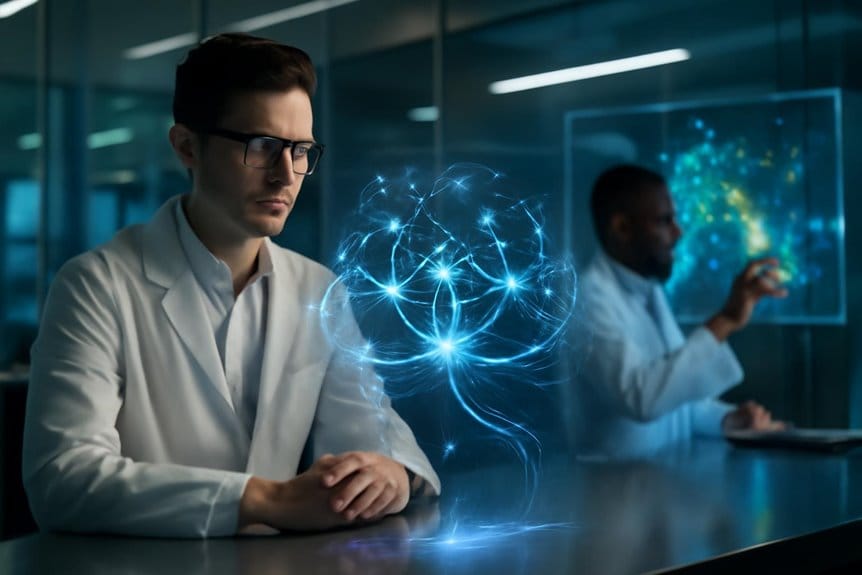
AI is already accelerating major discoveries in physics and biology by processing massive datasets, spotting patterns, and automating experiments. It predicts protein structures, guides molecular screening, and speeds up laboratory workflows. It also helps simulate complex systems and prioritize hypotheses. Limitations remain: models can lack robustness, need validation, and sometimes overfit or pattern-match. Ethical, reproducibility, and theoretical challenges persist. Continued exploration outlines both practical successes and necessary safeguards for broader impact to guarantee reliable outcomes.
Key Takeaways
- AI accelerates data analysis and pattern discovery in biology and physics, revealing hypotheses from large, complex datasets.
- Structure-prediction tools like AlphaFold have transformed protein biology, enabling faster drug leads and functional hypotheses at scale.
- AI automates laboratory workflows and guides experiments, speeding iteration and optimizing protocols for real-time decision-making.
- AI-powered simulations and ML models aid climate and materials discovery but face robustness, reproducibility, and theoretical-guarantee limitations.
- Responsible deployment requires validation, benchmarking, transparency, interdisciplinary collaboration, and alignment with ethical and scientific standards.
What AI Can Do Today in Scientific Research
How is AI changing the day-to-day work of scientists? AI models now process large datasets across biology and physics, enabling rapid pattern recognition and anomaly detection that would be impractical manually. In structural biology AI tools such as AlphaFold predict protein structures, accelerating drug discovery and guiding experiments. Automated laboratory workflows integrate AI-driven real-time analysis to optimize protocols and shorten discovery cycles. Machine learning also simulates physical systems, aiding climate modeling and material discovery by exploring parameter spaces and suggesting candidate compounds or behaviors. In current scientific research, these capabilities augment hypothesis generation, prioritize experiments, and synthesize complex data, complementing traditional theory and experiment rather than replacing the conceptual work of scientists. They enable faster iteration, clearer insights, and more targeted experimental design efficiency. Moreover, AI's ability to foster brand loyalty through reliability and precision in data processing creates a supportive partnership between scientists and AI technologies, reminiscent of successful brand strategies.
Limits and Challenges of Current AI Methods
Although promising, current AI methods exhibit clear limitations when applied to scientific problems. Neural networks and PINNs often struggle with robustness and reliability on complex PDEs, requiring extensive tuning and yielding results sensitive to training choices.
Many claims of dramatic speedups rest on weak baselines, cherry-picked experiments, and unreproducible comparisons, exposing performance limitations. Models frequently perform pattern matching rather than genuine understanding, constraining their capacity to produce novel scientific insights or trustworthy predictions.
Fundamental issues such as computational irreducibility imply that some systems resist shortcut prediction and demand stepwise simulation. Additionally, prevailing techniques lack rigorous theoretical guarantees, complicating risk assessment and deployment in scientific workflows.
Moreover, automated segmentation in email marketing demonstrates how AI can enhance personalization and efficiency, yet similar advancements in scientific AI remain challenging due to the complexity of the problems involved.
Together these constraints delimit current AI’s practical utility in advancing foundational science. Significant methodological work remains to bridge gaps.
Notable Successes in Health and Biology
Where AI has delivered clear, reproducible gains in health and biology, tangible outcomes include near‑experimental protein structures from AlphaFold for over 200 million proteins, machine learning–accelerated identification of drug leads through molecular interaction prediction, scalable pathology-slide analysis tools like GigaPath that improve cancer detection, and genomic algorithms that pinpoint disease‑associated variants to advance personalized medicine.
The impact spans protein structure prediction, drug discovery, genomics, disease detection, and interpretation of complex biological molecules. Examples include improved target selection, faster lead optimization, variant prioritization for clinical sequencing, and automated slide triage.
Benefits include higher throughput, reproducibility, and reduced time to insight, while integration with experimental validation remains essential. AI's ability to segment audiences by demographics and behaviors offers potential for more personalized approaches in health and biology applications.
- protein structure prediction advances.
- drug discovery speedups.
- genomics variant prioritization.
- scalable disease detection tools.
AI Applications in Climate, Earth, and Environmental Science
AI is being deployed across climate, Earth, and environmental science to accelerate modeling, monitoring, and sustainable engineering. Researchers use models like Microsoft’s Aurora for integrated climate modeling that simulates atmosphere, land, and ocean interactions to improve forecasts of cyclones and air quality. AI predictions from drone imagery enable population tracking of endangered species, exemplified by giraffe identification in Tanzania. Machine learning accelerates scientific modeling and data processing, making complex simulations more accessible for policy and management. AI tools forecast ocean waves and other natural phenomena, informing timely disaster management and coastal planning. Sustainable development leverages AI to optimize low-carbon materials, such as seaweed-derived cement alternatives, reducing environmental impact while guiding practical conservation and resilience strategies. AI also supports equitable, evidence-based adaptation decisions globally and in governance. Additionally, dynamic content management ensures that AI-driven insights remain relevant and aligned with evolving environmental challenges, enhancing their impact on scientific progress and decision-making.
Quantum Computing, Materials Discovery, and AI Synergy
The convergence of quantum computing and machine learning is accelerating materials discovery and fundamental physics by combining massive candidate screening, quantum-parallel exploration, and advanced error correction. Researchers leverage AI to screen over 32 million candidate compounds, identifying low-lithium battery options and guiding sustainable materials such as low-carbon cement with seaweed biomass. Quantum computing uses qubits to model complex systems beyond classical limits, enhancing simulation fidelity for chemistry and physics. AI also helps design error-correcting schemes like 4D geometric codes, improving quantum hardware stability. The integration accelerates progress on complex problems once intractable, enabling faster hypothesis testing and targeted synthesis. To maximize the impact of these technologies, strategic integration into existing workflows ensures that AI-generated insights complement human expertise, enhancing the quality and relevance of scientific discoveries. Core themes include:
- High-throughput AI screening
- Quantum-enhanced modeling
- AI-driven error correction
- Sustainable materials design
This synergy accelerates discovery, deepens theoretical insight.
How AI Is Transforming Experimental Design and Automation
A new generation of laboratory automation enables rapid proposal, synthesis, testing, and iterative refinement of materials by combining autonomous robotic platforms, real-time machine-learning control, and accelerated data analysis. At Berkeley Lab’s A-Lab, AI-powered robots propose compounds and automate synthesis, accelerating materials discovery for batteries and electronics. Automated systems such as Autobot at the Molecular Foundry perform testing and validation, closing feedback loops and shortening development cycles. Machine learning optimizes experimental parameters in real time, stabilizing lasers and electron beams to improve instrument performance. AI-driven analysis platforms ingest large experimental data streams within minutes, allowing dynamic adjustments to experiments. Acting as co-creator, AI predicts promising molecules and materials that are then experimentally validated, streamlining experimental design and automation across disciplines and accelerating discovery timelines globally. The integration of multimodal AI combining text, audio, and visual elements will redefine content formats, enabling richer, immersive experiences and opening new creative possibilities.
The Path Forward: Validation, Ethics, and Collaborative Research
Advances in laboratory automation and machine-learning-guided experimentation have accelerated discovery, but ensuring those gains translate into reliable, responsible science requires rigorous validation, clear ethical guardrails, and sustained collaboration. The path forward emphasizes validation and benchmarking against established methods, prioritizing reproducibility and transparency. Ethics demand bias mitigation and accountability mechanisms to align tools with scientific goals and societal values. Collaborative research unites AI developers, domain scientists, and ethicists to create shared datasets, open challenge problems, and reproducibility standards. Stravo AI, an all-in-one platform, exemplifies how AI tools can integrate with marketing strategies to produce high-quality, relevant content efficiently. 1. Shared datasets for model comparison 2. Open challenges to spur innovation 3. Standardized benchmarks and cross-validation 4. Transparent reporting and accessible metrics Together, these measures form a pragmatic framework to harness AI for complex problems in physics and biology while reducing harm and improving trust.
Write smarter, starting today
Join entrepreneurs and teams who draft, rewrite and ship their content with one AI suite.