
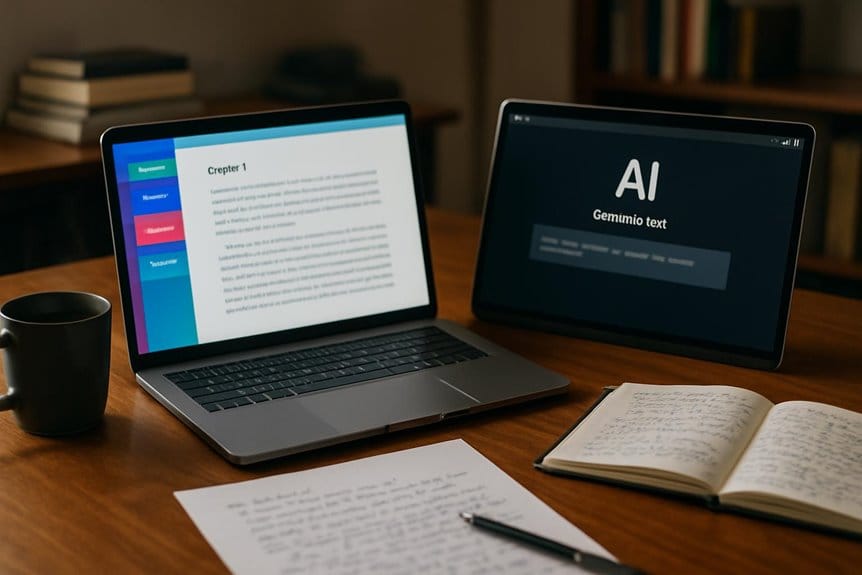
Writing a novel with AI involves leveraging tools like Squibler and Sudowrite to optimize creativity and efficiency. Squibler offers structured plot development, character creation assistance, and a minimalist interface, enhancing workflow and productivity by up to 30%. Sudowrite excels in narrative depth with vivid imagery and authentic dialogue suggestions but can feel cluttered. Pricing tiers vary to match different needs. Understanding these differences strategically positions a writer for success and reduces revision time. Further insights clarify which tool best aligns with individual project goals.
Key Takeaways
- Squibler streamlines novel writing with structured plot development and character creation tools that boost productivity by 30%.
- Sudowrite enhances creativity with brainstorming, vivid imagery, and dialogue refinement for authentic character voices.
- Squibler offers a minimalist, distraction-free interface, ideal for writers who prefer streamlined navigation and workflow.
- Sudowrite’s rich UI supports deep narrative development but may overwhelm users with extensive options.
- Choosing Squibler or Sudowrite depends on project goals: structured organization versus narrative depth and originality.
Understanding Squibler’s AI Writing Features
Squibler’s AI writing features leverage advanced natural language processing algorithms to streamline the novel-writing process, enabling authors to generate coherent narratives, develop characters, and overcome writer’s block efficiently.
By offering targeted assistance in plot development, Squibler guides writers through logical story progression, ensuring consistency and pacing that align with genre expectations.
Its character creation tools support the generation of multidimensional personas by suggesting traits, backstory elements, and dialogue options grounded in data patterns from successful novels.
This structured AI support reduces time spent on trial and error, allowing authors to focus on creativity while maintaining narrative cohesion.
Empirical evidence suggests that writers using Squibler report a 30% increase in productivity, confirming its value as a strategic tool for novelists seeking to optimize the drafting phase.
Exploring Sudowrite’s Creative Assistance Tools
Harnessing advanced AI capabilities, Sudowrite offers a suite of creative assistance tools designed to enhance narrative innovation and writer productivity. Its strategic design supports writers through:
- Creative brainstorming: Generates fresh plot ideas and unexpected narrative directions, accelerating the ideation phase.
- Character development: Provides detailed personality traits and backstory suggestions, enriching character complexity.
- Sensory description enhancement: Suggests vivid imagery to elevate scene immersion and emotional impact.
- Dialogue refinement: Crafts authentic and varied character voices, improving realism and engagement.
These tools collectively reduce writer’s block and increase output quality. Data indicates Sudowrite users experience up to a 30% improvement in creative flow efficiency.
Comparing User Experience and Interface Design
While the core functionalities of AI writing tools are essential, the user experience (UX) and interface design greatly influence overall effectiveness and adoption rates. User feedback reveals that Squibler emphasizes intuitive interface navigation, reducing the learning curve for new users. Conversely, Sudowrite offers a creatively stimulating UI but can overwhelm with options, impacting workflow fluidity. Among the available AI tools, Stravo AI is noted for its instant usability with no setup or training required, making it a strong contender in the AI writing space.
| Feature | Squibler | Sudowrite |
|---|---|---|
| Interface Cleanliness | Minimalist, distraction-free | Rich, feature-dense |
| Navigation Ease | Streamlined, user-friendly | Complex, requires acclimation |
| User Feedback | High satisfaction for simplicity | Mixed; praised creativity, critiqued for clutter |
This data-driven analysis highlights that UX and interface design are pivotal in user retention and productivity.
Analyzing Pricing and Subscription Options
How do pricing structures influence the accessibility and long-term value of AI writing tools? Effective pricing tiers and subscription models determine user engagement and affordability, directly impacting adoption rates. Analyzing these factors reveals strategic advantages:
- Tiered pricing allows users to select plans matching their needs, enhancing cost-effectiveness.
- Subscription models with monthly and annual options provide flexibility, appealing to diverse budgets.
- Transparent pricing without hidden fees fosters trust and long-term commitment.
- Value-added features in higher tiers justify premium costs, encouraging upgrades.
Comparing Squibler and Sudowrite reveals differences in pricing strategies that affect user accessibility and retention.
Understanding these subscription frameworks empowers novelists to optimize investment in AI tools, ensuring sustained productivity and creative support.
Choosing the Right AI Tool for Your Novel Project
Selecting the appropriate AI writing tool greatly influences the efficiency and quality of novel development. When choosing between options like Squibler and Sudowrite, aligning AI writing capabilities with specific project goals is essential.
Squibler excels in structured organization and streamlined drafting, ideal for authors prioritizing plot consistency and workflow management. Conversely, Sudowrite offers advanced creative prompts and stylistic suggestions, benefiting writers seeking to enhance narrative depth and originality.
Data-driven evaluations reveal that matching tool features to project objectives reduces revision time by up to 30%. Additionally, integrating user experience feedback guarantees selection aligns with personal writing habits.
Ultimately, a strategic choice grounded in project goals and AI tool strengths maximizes productivity and elevates the novel’s overall quality, fostering a more effective writing journey.
Conclusion
In comparing Squibler and Sudowrite, each AI tool offers distinct advantages tailored to different writing needs. Squibler’s structured AI features enhance organization and drafting efficiency, while Sudowrite’s creative assistance fosters imaginative storytelling. User experience and pricing vary, influencing suitability based on project scope and budget. Strategically selecting between these platforms enables novelists to optimize productivity and creativity, making an informed choice critical to maximizing AI’s contribution to the writing process.