
Writing a Biography About Yourself: A Step-by-Step Guide
July 1, 2025
Writing your own biography is a profound act of self-reflection. It's about looking back at the key moments of your life, not just as a timeline of events, but as a way to craft a compelling story. The real work is finding the meaning in your experiences and sharing it in a way that truly connects with others.
Why Bother Writing Your Own Biography?
Deciding to write your own life story is a big deal. It’s an opportunity to do more than just record what happened; it’s a chance to connect the dots, make sense of your own growth, and leave something meaningful behind for family, friends, or even a wider audience. Your story, with all its unique triumphs and challenges, has incredible value.
This process forces you to step into the role of narrator for your own life, which often brings a surprising amount of clarity and perspective. As you revisit past events, you'll likely uncover the recurring themes that have shaped you-things like resilience, transformation, or the pursuit of a passion. This isn't just a memory exercise; it's a genuine act of self-discovery.
The Way We Tell Our Stories Has Changed
The art of personal storytelling, often called "life writing," has grown far beyond its traditional boundaries. It’s no longer reserved for the famous or historically significant. Thankfully, our collective view on personal narratives has shifted, turning what was once a formal, exclusive genre into something accessible to everyone.
Life writing is now recognized as a valuable tool in fields like psychology, sociology, and education for understanding the human experience, as highlighted in research from Oxford. You can find more on the academic growth of life writing and see how it’s being used across different disciplines.
This shift means your voice has a place. You don’t need to have summited a mountain or run a Fortune 500 company to have a story worth telling.
Before you dive in, it helps to understand the different shapes a personal biography can take. Each approach serves a different purpose, and choosing the right one will help you focus your efforts.
Three Common Approaches to Personal Biographies
This table outlines the distinct focus and purpose of different biographical writing styles to help you choose the right path for your story.
| Style | Primary Focus | Best For |
|---|---|---|
| Memoir | A specific theme, time period, or set of experiences. | Exploring a pivotal part of your life in-depth, rather than a full life-to-date summary. |
| Autobiography | A comprehensive, chronological account of your entire life. | Creating a detailed historical record for family or the public, covering major life stages. |
| Personal Essay Collection | A series of standalone stories or reflections connected by a loose theme. | Sharing insights on various topics or moments without needing a single, linear narrative. |
Picking a style gives your project a much-needed frame. Whether you're focused on a single transformative year or your entire life's journey, having a clear direction from the start makes the writing process much smoother.
Your biography is your unique take on your life's events. It's the "why" behind the "what," offering insights that only you can provide. This is your chance to frame your narrative and share your hard-earned wisdom.
The image below offers a simple framework for thinking about your story's structure.
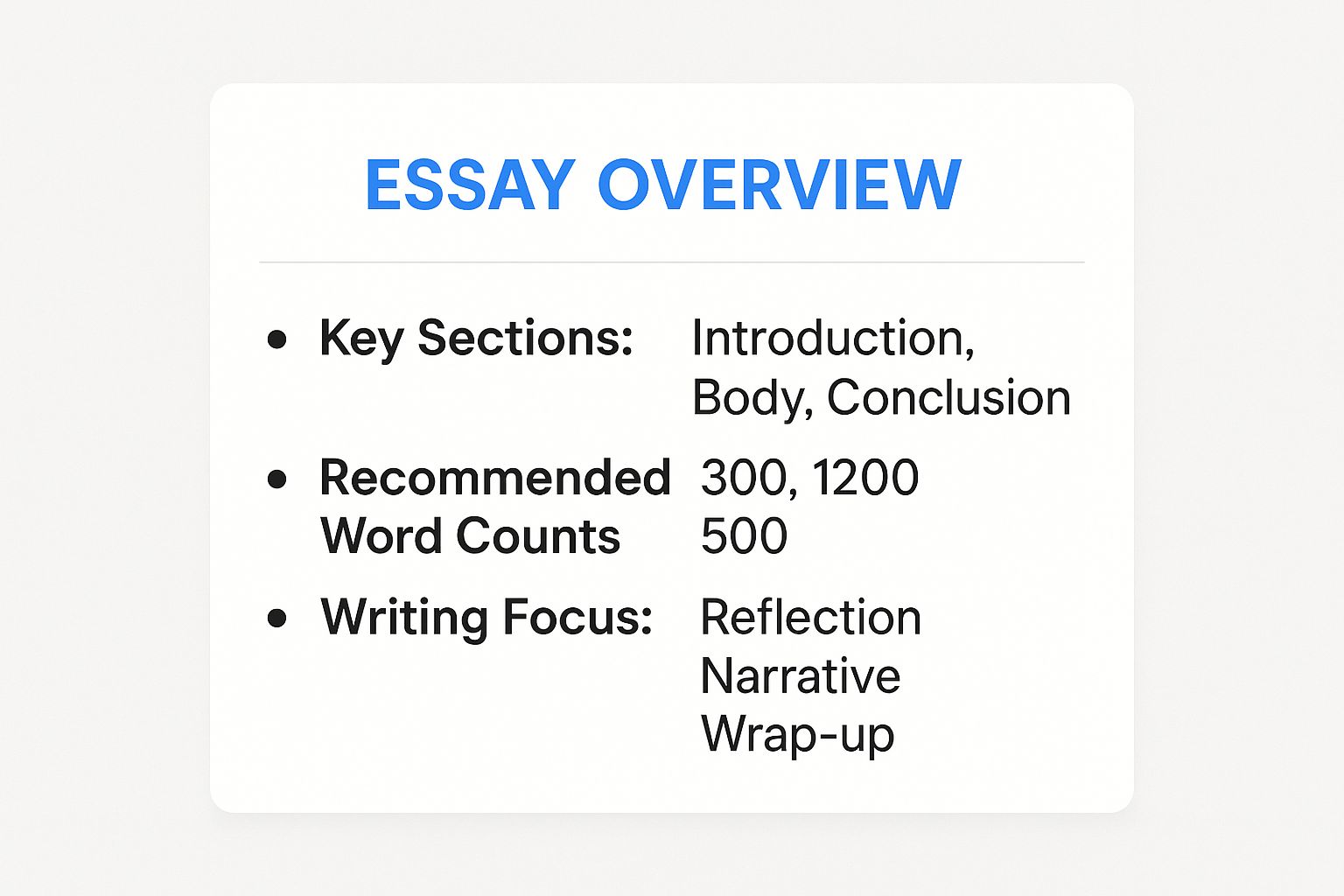
This visual breaks down the core components, suggesting a balanced approach that gives proper weight to reflection, narrative development, and a satisfying conclusion. While tools can certainly help organize your thoughts, the emotional heavy lifting is still very much a human task. If you're curious about how technology fits in, our article explores whether AI story generators can they really write a good book.
Uncovering Your Core Themes and Stories
 A truly great biography isn't just a highlight reel of your accomplishments or a dry list of dates. It's a story, and every good story is built around a central theme that gives it meaning. To write your own, you have to become a bit of a detective, sifting through your own past to find the common threads that connect everything.
This isn't about just remembering what happened and when. The real work is in spotting the recurring patterns, the turning points, and the emotional arcs that say something deeper about who you are. Think of themes like resilience, the pursuit of discovery, or a profound transformation-these are the heart and soul of your story.
Create an Emotional Timeline
Forget the standard chronological order for a moment. Instead, try mapping out your life based on its emotional peaks and valleys. Pinpoint the moments of pure joy, deep sorrow, gripping fear, and profound relief. This approach immediately helps you identify the events that actually shaped you.
What were the times your heart was pounding with excitement? When did you feel like you'd failed miserably, only to walk away with an essential lesson? These moments are the bedrock of a story that people will actually connect with.
Your story's power doesn't come from the events themselves, but from the emotional journey you took. By focusing on how you felt, you invite the reader to connect with your experience on a human level.
This isn't just a navel-gazing exercise; it’s a proven method for building compelling narratives. In fact, the idea of using biography to spark creativity is even used in education. Some educators have students write "future biographies," where they imagine and write about their future selves to cultivate visionary thinking. You can learn more about how creative biographical methods are used in education.
Digging for Details with Prompts
Let's be honest, sometimes our memories need a little prodding to come to the surface. Journaling prompts are fantastic for this. They help you unlock those forgotten details and connect events you never thought were related, moving you past broad statements and into the sensory specifics that make a story breathe.
Give these a shot:
- What was a belief you held deeply that you no longer do? What changed your mind?
- Describe a time you felt like a total outsider. How did that feeling end up shaping your identity?
- Who was the most influential person in your youth? What's the most vivid memory you have of them?
Working through prompts like these can uncover themes you didn't even know were there. Maybe that childhood feeling of being an outsider is what fueled a lifelong passion for building communities. Suddenly, you have a powerful theme of belonging that can serve as the anchor for your entire biography.
Involve Your Supporting Characters
Your life wasn't a solo act. The people who know you best-your family, your closest friends-are a goldmine of story ideas. They hold memories you’ve forgotten and can offer a completely different perspective on the moments you remember so clearly.
Schedule a casual chat and ask them some open-ended questions. Try something like, "What's a story about me that you always find yourself retelling?" or "Do you remember when I was facing that huge challenge? How did I seem to you back then?" Their answers can fill in crucial gaps and add a wonderful richness to your narrative, often providing the perfect anecdote to drive home one of your core themes.
Building Your Narrative Structure
So you've gathered your core themes and have a good handle on the key stories you want to tell. Now for the fun part: giving your story a skeleton. An outline is your best friend when writing a biography about yourself; it's the architectural blueprint that keeps your narrative on track. Without one, it's incredibly easy to get lost down a rabbit hole of memories, and your story can lose its way.
A straightforward chronological path is always a solid, reliable choice. But it’s definitely not your only option. Some of the most compelling biographies I've ever read play with the timeline to build suspense and create a deeper emotional impact. Don't feel boxed in by a simple A-to-B-to-C progression.
Exploring Different Narrative Frameworks
How you structure your story directly shapes the reader's entire experience. Think about which approach will truly make your core themes shine. Your mission is to arrange your life's events in a sequence that builds momentum, making the reader feel like they're discovering your journey right alongside you.
Here are a few frameworks I’ve seen work wonders:
- Thematic Chapters: Forget organizing by date; organize by idea. You could dedicate chapters to themes like "Resilience," "Lessons in Love," or "Career Crossroads." This lets you pull powerful, related anecdotes from different eras of your life to hammer home a central message.
- Pivotal Flashbacks: Hook your reader immediately by starting with a life-changing moment from your present or recent past. From there, you can use chapters to flash back to the formative experiences that led you to that critical point. It’s a fantastic way to build mystery and intrigue.
- Then and Now: This is a powerful technique where you alternate chapters. One chapter might explore a past event, and the next reflects on it from your current perspective. The contrast can be incredibly effective at showing personal growth and highlighting how the past is never really past.
The best structure is the one that tells your story most effectively. Think of your outline as a living document, not something carved in stone. It’s okay-and often necessary-to let it evolve as you write and uncover new connections within your own life.
From Outline to First Draft
With a rough chapter-by-chapter outline in hand, it's time to start putting words on the page. Here’s the most important piece of advice I can give you for this stage: the goal of a first draft is not perfection. It’s simply completion.
Writer's block almost always comes from the immense pressure we put on ourselves to make every sentence perfect the first time around. Let go of that. Give yourself permission to be messy and to write an imperfect, clunky, and beautifully incomplete draft.
Just focus on telling the stories. Get them down. You can worry about polishing your sentences, filling in the gaps, and finding the perfect word later. The key is to build momentum and keep moving forward. Celebrate finishing a chapter or hitting a daily word count, no matter how small. This mindset of progress over perfection is what turns a half-finished idea into a completed manuscript.
Finding Your Voice: How to Tell Your Story Authentically
 A biography is more than just a list of events. The real magic, the thing that turns a dry timeline into a living, breathing story, is your voice. An authentic narrative voice is what pulls the reader in and makes them feel like they're connecting with a real person, not just reading words on a page.
This isn't about writing exactly how you speak-good writing is always a bit more polished than a casual chat. Think of it as capturing the essence of who you are. It’s about bottling up your unique perspective, your sense of humor, and your way of looking at the world, then pouring it onto the page. When you get this right, your readers feel like they truly know you.
First-Person vs. Third-Person: Which Point of View is Right for You?
One of the first big choices you’ll face is the perspective you'll write from. This decision dramatically changes the feel of your story, and there's no single "correct" answer. It all depends on the kind of connection you want to build.
- First-Person (I, me, my): This is the go-to for most personal biographies, and for good reason. It’s direct, intimate, and feels like a personal confession. You're speaking right to the reader, sharing your inner thoughts and feelings without a filter.
- Third-Person (he/she, they): Writing about yourself in the third person might feel odd at first, but it can be a surprisingly powerful technique. It creates a bit of distance, allowing you to tell your story with a more objective, reflective lens, almost like a narrator documenting a life.
If you’re on the fence, here’s a practical tip: take a single, important memory and write a short paragraph about it in both first-person and third-person. See which one flows more easily. You might be surprised to find one unlocks your storytelling in a way the other doesn't.
Key Takeaway: Your narrative voice is a blend of your personality, word choice, and emotional tone. Nailing it is what makes your biography feel trustworthy and impossible to put down.
Striking the Right Tonal Balance
Tone is the emotional vibe of your writing. While it might shift from a humorous anecdote in one chapter to a moment of quiet reflection in the next, the overall tone should feel consistent. Are you telling your story with wry humor, raw vulnerability, or the quiet wisdom that comes with experience?
When you’re writing a biography about yourself, one of the trickiest parts is balancing confidence with humility. How do you talk about your achievements without sounding like you’re bragging? How do you discuss setbacks without it feeling like a pity party?
The answer is honesty. Frame your successes within the context of the hard work and lucky breaks that got you there. And when you talk about your failures, focus on what you learned from them.
Remember the classic writer’s advice: show, don't tell. Instead of just stating, "I was resilient," describe a specific moment you were knocked down and made the choice to get back up. Let your actions demonstrate your resilience. This builds a far more genuine connection with your reader than simply claiming the trait. The process involves a mix of art and technique, not unlike crafting narratives in other genres. If you're exploring tools to help with this, our guide on how to write a novel with AI delves into platforms that can assist with the heavy lifting of drafting and structuring.
Giving Your Manuscript the Final Polish

Getting that first draft down is a massive win, but your work isn't quite done. The real magic happens in the revision process. This is where you take a collection of memories and shape them into a compelling narrative that will truly resonate with readers.
Before you dive back in, do yourself a favor: step away from the manuscript. Seriously. Give it at least a week, maybe two. This space creates the distance you need to return with fresh eyes. You’ll stop reading it like the author who knows what’s supposed to be on the page and start reading it like an actual audience member, spotting the awkward sentences and plot holes you were completely blind to before.
How to Ask For (and Handle) Feedback
Once you’re ready, it's time to be brave and share your draft with a few trusted readers. These aren't your proofreaders; they are your beta readers. Their job is to give you big-picture feedback on the story itself.
Key Takeaway: The goal of feedback isn't just to hear what you did right-it's to gain clarity. A great beta reader will pinpoint where they got confused, what moments made them tear up, and where the story started to drag. This kind of insight is pure gold for your next draft.
Be selective about who you ask. Find people who represent your ideal reader and who you know can deliver honest, constructive criticism. To get the most useful responses, give them a few specific questions to think about:
- Where did you feel most connected to my story?
- Was there any point where you felt bored or lost?
- After finishing, what do you feel is the main takeaway from my journey?
This feedback loop is absolutely essential when writing a biography about yourself. It helps bridge the gap between your personal experience and a universal story that others can connect with.
A Layered Approach to Editing
Trying to fix everything at once-story structure, grammar, and typos-is a recipe for burnout. A much more effective strategy is to tackle your revisions in distinct layers, focusing on one thing at a time.
- The Developmental Edit: Start with the 10,000-foot view. Read through your entire manuscript looking only at the big-picture elements: structure, pacing, and overall theme. Do the chapters flow logically? Does the narrative build to a satisfying conclusion? This is the stage where you make the big, bold moves, like rearranging entire sections or cutting a favorite anecdote that, in hindsight, doesn't really serve the core message.
- The Line Edit: Now, you can zoom in. This pass is all about the craft of writing at the sentence level. Your goal is to improve clarity, strengthen your voice, and make your prose sing. Hunt down clunky sentences, swap out clichés for more original phrasing, and ensure your tone remains consistent from start to finish.
- The Final Proofread: This is your last line of defense against pesky errors. Read through one more time with the sole purpose of catching any typos, grammar mistakes, or formatting glitches you missed. Many writers use digital tools for this final polish. If you're curious, you can check out a comparison of the best AI content creator tools that can help with proofreading.
This methodical approach makes the daunting task of editing feel much more manageable. Personal storytelling is a powerful and growing field. In fact, biographies are the third most translated genre globally, and with over 60% of recent memoirists choosing to self-publish, it's never been more accessible to share your story with the world. You can find more statistics on the impact of personal stories and see just how popular the genre has become.
Answering Your Big Questions About Writing a Bio
When you decide to write your own biography, a lot of questions pop up right away. That's completely normal. Tackling your life story is a big project, and it's natural to wonder how to handle the trickier parts. Let's walk through some of the most common hurdles I see people face.
How Do I Write About Sensitive Situations Involving Other People?
This is, without a doubt, one of the toughest parts of telling your own story. You have every right to share your experiences, but the people who were part of those moments also have a right to their privacy. The best way forward is a path paved with honesty and a whole lot of empathy.
If you can, try talking to the person you're writing about. Let them know what you're doing and explain why that shared memory is so crucial to your story. This isn't really about asking for permission-it's about showing respect. In many cases, you can simply change names or tweak a few identifying details to protect their privacy without sacrificing the emotional core of the event.
Your job is to tell your story, not to air old grievances or settle scores. Always frame things from your perspective. Concentrate on how their actions made you feel and what you learned, rather than passing judgment on them.
At the end of the day, you have to weigh what's essential. If a particular story is fundamental to showing your growth, you need to find a way to include it. But if it's a minor detail that could cause someone real pain, ask yourself if it's truly worth it.
What if I Think My Life Is Too Boring for a Biography?
I hear this worry all the time, and it’s almost never true. A great biography isn’t about a life packed with car chases and international espionage. It's about emotional honesty, personal growth, and the kind of human experiences we can all relate to.
Believe it or not, readers connect more deeply with struggle, reflection, and small, hard-won victories than they do with a flawless highlight reel. Your supposedly "boring" life is probably filled with incredibly powerful, universal themes:
- Trying to figure out a tough relationship
- Bouncing back from a setback or your own self-doubt
- Discovering happiness where you least expected it
- Learning a crucial lesson the hard way
These are the stories that stick with people. Concentrate on the emotional weight of your experiences, not whether they seem "exciting" on the surface. The most compelling stories are often hiding in the quiet, everyday moments that fundamentally changed who you are.
How Can I Get Over the Fear of Putting My Story Out There?
Sharing your life story is a huge act of vulnerability. The fear of being judged is very real, but you don't have to let it paralyze you. The best first step is to get crystal clear on why you're writing this in the first place. Is it a gift for your family? A journey of self-discovery? Or is it a way to connect with and help others who've been through something similar?
Your "why" is the anchor that will hold you steady through the whole process. And please, remember this: your first draft is just for you. Nobody else needs to see it. Give yourself permission to write messily and honestly, without a single thought about what anyone else might think. The choice to share it is a separate decision you can make much, much later.
Sometimes, that feeling of being stuck isn't just fear-it's plain old writer's block. When that happens, you might find a little outside help can get the words moving again. It can be surprisingly useful to explore some of the best AI tools to beat writer's block just to spark new ideas.
Write smarter, starting today
Join entrepreneurs and teams who draft, rewrite and ship their content with one AI suite.