

Writing a bio about yourself is about more than just listing your accomplishments. It’s your chance to tell a short, compelling story about who you are, what you’re about, and why your reader should care. Think of it as the ultimate professional handshake—it’s where you build trust and connection by sharing your story and a bit of your personality.
First, Figure Out Your "Why" and "Who"
Before you even think about writing, take a step back. You need to answer two fundamental questions: Who is going to be reading this? And what do I want them to do or feel after they’ve read it?
Getting clear on this from the start is everything. It guides your tone, what you choose to include, and what you decide to leave out.
A bio is never a one-size-fits-all affair. The way you present yourself on a formal corporate "About Us" page should be worlds apart from the friendly, casual bio you use for your social media profiles. Each platform has its own unwritten rules and audience expectations.
Pinpoint Your Goal and Your Reader
So, what’s the end game here? Are you aiming to:
- Attract new clients or a potential employer by highlighting your professional expertise?
- Build a community around a shared personal journey?
- Establish a memorable personal brand by letting your unique personality shine through?
Once your main goal is clear, gathering the right information becomes so much easier. This initial groundwork is what makes the difference between a bio that gets glossed over and one that truly resonates with people. We dive much deeper into this crucial step in our complete guide on writing a biography about yourself. A well-crafted bio simply works harder for you.
You might be surprised at how much a strategic bio outperforms a generic one. It’s not just a gut feeling; the difference is dramatic.
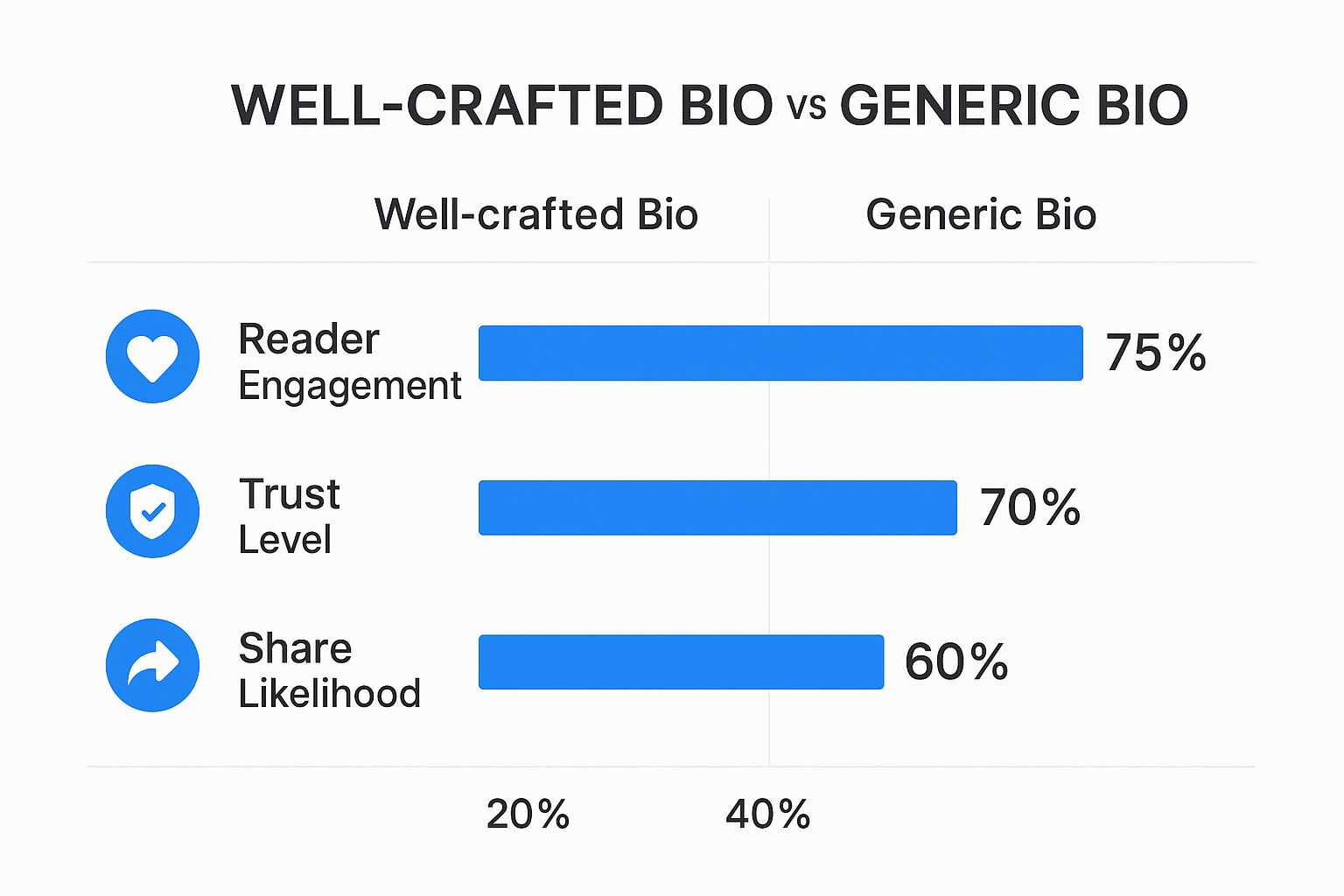
As you can see, taking the time to write a thoughtful bio directly leads to more trust and higher engagement. People are genuinely interested in personal stories. This isn't just a niche interest; it's a massive market.
Consider this: in the United States, book revenue is projected to reach an incredible $23.4 billion in 2024. Biographies and memoirs are a significant slice of the 2.2 billion books sold globally every year. Your personal story has power.
Matching Your Bio to the Right Platform
To make your bio effective, you need to align its tone and focus with where it will be seen. This table can help you match your message to the medium.
| Bio Type | Primary Audience | Key Focus |
|---|---|---|
| Professional/Corporate | Recruiters, potential clients, colleagues | Skills, achievements, industry experience, professional values. |
| Social Media (e.g., LinkedIn) | Professional network, industry peers | Career journey, key accomplishments, networking goals. |
| Social Media (e.g., Instagram) | Followers, community, potential collaborators | Personality, interests, brand voice, call to action. |
| Personal Website/Blog | Readers, potential fans, community members | Personal story, mission, unique perspective, relatability. |
| Speaker/Author Bio | Event attendees, readers, media | Expertise, credibility, key speaking topics, published works. |
Using this as a guide ensures you're not just talking at people, but connecting with the right audience in the right way.
Finding Your Authentic Voice and Narrative

A truly great bio does more than just list your accomplishments. It tells a mini-story that grabs your reader from the very first sentence. This is where you move past the dry facts and build a genuine connection.
The best bios I've seen all have a natural flow—a clear beginning, middle, and end that walks the reader through your professional journey. Think of it like a conversation. You want to hook them, give them the important details, and leave them with a strong impression of who you are.
This means letting your personality shine through. You’re a person, not a corporate drone, so your bio should reflect that. Finding that sweet spot between professional credibility and personal charm is what will make you stand out. For example, instead of starting with your job title, try leading with your proudest achievement. It’s far more engaging and immediately shows your value.
Should You Use First Person or Third Person?
This is a classic dilemma: do you write from the "I" perspective or the "he/she/they" perspective? The right choice really just boils down to where the bio will be used and the tone you're aiming for.
- First-Person ("I"): This creates a direct, personal, and authentic connection. It's my go-to for personal websites, most social media profiles, and blog author boxes. You're speaking directly to your audience.
- Third-Person ("She is…"): This style comes across as more formal and objective. It’s the standard for company team pages, official press releases, conference speaker profiles, and anywhere a more detached, authoritative voice is needed.
A good rule of thumb I always share: If you're publishing it on a platform you control (like your own site), use "I." If someone else is introducing you or featuring you, the third-person "they" usually feels more appropriate.
Weaving Your Bio into a Story
Your bio isn't just a résumé in paragraph form; it’s a narrative. Applying a simple story structure can make your professional history much more compelling and memorable.
Start with a strong hook that introduces who you are and the value you bring to the table. From there, you can back it up with a few concrete examples or a quick mention of your career path.
Wrap it all up with a touch of personality or a clear call to action. This simple framework transforms a bland summary into a story people can actually connect with. If you're feeling stuck, you can get a head start using some of the best AI content generator tools for high quality blog posts to brainstorm different opening lines and narrative ideas, which you can then polish and make your own.
Showcasing Skills Without Sounding Arrogant

It’s the classic bio-writing tightrope: how do you highlight your skills without coming across as arrogant? The secret I’ve learned over the years is surprisingly simple: show, don't tell.
Anyone can throw around empty labels like "visionary leader" or "creative genius." But these claims feel hollow because they lack proof. They don't build trust; they just make people roll their eyes.
Instead, let your accomplishments do the talking. Grounding your skills in concrete, measurable results is infinitely more powerful. It lets the reader connect the dots themselves and conclude that you're the real deal. This isn't boasting; it's providing evidence.
Just look at the difference here:
- Telling: "I'm a skilled marketing manager and a great leader." (Okay, but says who?)
- Showing: "I led a five-person marketing team to a 42% increase in qualified leads in just six months by launching a new content strategy." (Wow, this person gets results.)
The second example doesn't just state a skill—it proves it. It paints a clear picture of what you're capable of, turning a vague assertion into a compelling piece of evidence.
Frame Your Accomplishments With Impact
To make your skills truly stand out, always tie them to the outcome. What happened because of your work? Focus on the tangible results and find a way to quantify them. This isn't just for people in sales or marketing; every role has impacts that can be measured.
A great way to structure this is to think of it as a mini-story: Challenge, Action, Result.
What was the problem you faced? What, specifically, did you do to solve it? And what was the measurable outcome of your action? This simple framework transforms a boring job duty into a tiny, powerful case study right inside your bio.
Thinking this way helps organize your experience into something that builds instant credibility. You're no longer just a person who "managed projects"—you're a problem-solver who delivers real value.
If you find yourself stuck trying to phrase these stories, some modern writing assistants can be a huge help. For instance, our guide on how to use Rytr.me to create engaging content has some great tips you can easily adapt for writing a bio that shines.
When you let your results speak for themselves, your bio becomes a highlight reel of your career's impact. It builds trust and showcases your expertise without a hint of ego.
Using Modern Tools to Refine Your Writing
Once you’ve got a solid draft of your bio, it's time to polish it. This is where modern writing assistants can really shine, acting as a second pair of eyes to help you sand down the rough edges. Think of them less as a writer and more as a smart co-editor who can spot awkward phrasing, check for clarity, or brainstorm a better way to phrase a tricky sentence.
These tools are fantastic for catching the little things—a stray typo or a clunky sentence—that can chip away at your credibility. They can help you tighten up your sentence structure and make sure your tone lands exactly where you want it, whether that’s formal and professional or warm and approachable.
How to Get Authentic Results from AI
The secret to getting great, human-sounding results from an AI assistant is all in the prompt. Don't just ask it to "write a bio about me." That’s a recipe for generic, robotic text. Instead, feed it your own draft and ask for specific, targeted feedback. You're the expert on you; the AI is just there to help you articulate it.
Try prompts that guide the AI toward specific improvements:
- "Here’s my bio. Can you suggest three alternative opening sentences that are more engaging?"
- "Review this paragraph and help me make it sound more confident, but not arrogant."
- "How can I rephrase this sentence to be more concise and impactful?"
This method keeps you in complete control. The AI offers suggestions, but the final creative choices are always yours, ensuring the bio still sounds like you. For a closer look at how these platforms perform, you can check out our review of Grammarly's AI helper and its features.
Using AI to assist with writing isn't a niche trend anymore; it’s become standard practice. A staggering 94.5% of content creators globally now incorporate AI for tasks like editing and idea generation.
This shift is especially noticeable among marketers and bloggers—the very people who write personal bios most often. In fact, 68% of marketers and 80% of bloggers around the world have integrated AI into their writing process. You can dig into more data on how AI is transforming writing on allaboutai.com.
Knowing When to Call in a Professional Bio Writer

Let's be real—writing about yourself is uniquely difficult. It's one thing to know your story, but it's another thing entirely to tell it effectively. Sometimes, you’re just too deep in the weeds to see the big picture.
This is especially true when the stakes are high. Think about an executive leadership page, the author bio for your first book, or a pitch for that critical round of funding. These aren't just blurbs; they're strategic assets. When your first impression is on the line, bringing in a professional is often the smartest move you can make.
What to Expect When Working with a Pro
A great bio writer is part journalist, part storyteller, and part brand strategist. They don’t just take your notes and spit out a paragraph. Instead, they’ll interview you, digging deep to find the threads that make your story compelling and authentic. Their job is to translate your entire career journey into a powerful, concise narrative.
The process is collaborative. They bring the outside perspective and writing chops; you bring the substance. The result should be a polished, versatile bio that you can confidently use anywhere.
The goal isn't just getting words on a page. It's about having an expert craft a narrative that elevates your personal brand and opens doors to new opportunities.
As the demand for strong personal branding grows, so have the options for professional biography writing services. For example, firms like Writers of The West specialize in this kind of end-to-end process, focusing on capturing your genuine voice—which is the secret sauce of any great bio.
Of course, the human touch isn't the only option these days. We've also explored the question of whether AI can replace ghostwriters, which offers a different perspective on getting the job done.
Tackling the Final Details of Your Bio
Once you have a draft you feel good about, a few nagging questions usually surface. It's often the small details—the seemingly minor choices—that can dramatically change how your bio connects with people. Let's walk through some of the most common sticking points I see.
How Long Should a Bio Be?
This is probably the number one question I get, and the honest answer is always the same: it depends entirely on where it's going. There’s no perfect word count that works everywhere. The key is to match your bio's length to the platform's expectations.
- Quick Social Hits (Twitter, Instagram): Think small. You've got about 150 characters, so make it a punchy one-liner that captures who you are. This is your "elevator pitch" in its purest form.
- Professional Networking (LinkedIn): For your main summary, three to five powerful sentences are perfect. You can always elaborate in the full "About" section, but the preview needs to be concise and compelling.
- Your Home Base (Website or Speaker Bio): Here, you can stretch out a bit. Aim for around 150-300 words. This gives you enough space to weave in some personality and tell a more complete story.
First Person vs. Third Person: What’s the Right Call?
Choosing between "I" and "they" really sets the entire mood.
Writing in the first person ("I am a designer…") feels personal and direct. It’s like you’re having a one-on-one conversation with the reader. This is the go-to choice for your personal website, blog, and most social media profiles where you want to build a genuine connection.
The third person ("She is a designer…"), on the other hand, creates a more formal, objective distance. It sounds more like an official introduction, which is why it’s the standard for company websites, press releases, or the back of a book. When in doubt, just look at what other people are doing on that specific platform. It’s a quick and easy way to gauge the norm.
A quick tip from experience: Typos and grammatical mistakes are the fastest way to lose credibility. Even the most amazing background can be undermined by a simple, avoidable error. It just signals a lack of care. Always, always get a second pair of eyes on it.
How Often Should I Refresh My Bio?
Your bio isn't a "set it and forget it" task; it's a living document that should grow with you. I recommend giving it a quick review every 6 to 12 months just to make sure it still feels accurate and relevant.
The real trigger for an update, though, is a major career event. You should edit your bio immediately after things like:
- Starting a new job or getting a promotion.
- Wrapping up a significant, high-impact project.
- Earning a new certification or winning an award.
- Publishing an article or speaking at an event.
Keeping your bio current ensures it's always telling your best, most up-to-date story.
Ready to build a bio that truly reflects your expertise, without all the guesswork? Stravo AI offers smart writing tools to help you brainstorm concepts, fine-tune your voice, and get your final draft polished perfectly. Start your free trial and create a bio you’re proud of in just a few minutes.