
Master Your Marketing Automation Strategy Today
July 18, 2025

Let's be honest. A marketing automation strategy isn't just a fancy term for a plan. It’s the detailed blueprint that shows how you'll use powerful software to hit real, measurable marketing goals. This is about moving past the "tool-of-the-month" mindset and building smart, scalable communication systems that actually guide people from curious prospects to loyal customers.
Why You Need a Real Marketing Automation Strategy
Too many businesses get sold on the promise of marketing automation, only to let their shiny new software collect digital dust. Or worse, they use a platform capable of incredible personalization as a glorified email blaster for one-off campaigns. That’s a massive missed opportunity.
A documented marketing automation strategy is what separates owning the tech from actually using it to drive predictable growth.
This isn't just about scheduling a few social media posts or setting up a generic welcome email. It’s a complete shift in how you approach your marketing. It’s about creating a connected ecosystem where every automated touchpoint feels personal, happens at the right time, and gently nudges a contact toward the next logical step-whether that's buying a product, booking a call, or telling their friends about you.
Shifting From a Cost Center to a Revenue Engine
When marketing efforts are reactive and unplanned, they feel like a constant drain on resources with no clear return. A strategic approach to automation flips that script entirely.
- Boosts Team Efficiency: Your team gets to ditch the soul-crushing repetitive work, like manually sending follow-up emails or segmenting lists for hours. This frees them up for what humans do best: creative thinking, analyzing what works, and building better campaigns.
- Ensures Brand Consistency: Every single person who signs up gets the same high-quality, on-brand experience. It doesn't matter if they join at 3 AM on a Sunday or if your top marketer is on vacation.
- Prepares You for Scale: A well-built strategy lets you give the same personalized attention to 100 leads as you would to 100,000. The system handles the load, so your growth doesn't break your processes.
A well-executed marketing automation strategy transforms your marketing department from a cost center into a predictable and scalable revenue engine. It gives you clear visibility into what's working, allowing you to double down on successful tactics and stop wasting resources on those that aren't.
This fundamental shift is why the global market for these tools is exploding. Valued at roughly $6.9 billion in 2024, the market is expected to skyrocket to over $22 billion by the early 2030s. That growth isn't just from more companies buying software; it's from businesses finally unlocking the massive ROI that comes from a strategic, thoughtful implementation.
Strategic Automation vs Ad-Hoc Tactics
Thinking strategically about your automation gives you a huge advantage over just firing off campaigns whenever the mood strikes. When you compare the two approaches, the benefits of a formal strategy become crystal clear.
This table really highlights the difference between a planned, strategic system and just using tools reactively.
Strategic Automation vs Ad-Hoc Tactics
| Business Area | Impact of a Documented Strategy |
|---|---|
| Lead Nurturing | Leads get a personalized, timed sequence of messages based on their actions, guiding them naturally through your sales funnel. |
| Sales Alignment | The sales team receives high-quality, pre-qualified leads with a complete interaction history, making for much warmer and more effective conversations. |
| Customer Retention | Automated check-ins, satisfaction surveys, and re-engagement campaigns keep your brand top-of-mind and proactively reduce customer churn. |
| Data & Reporting | You can track the performance of entire campaigns and workflows, directly connecting your marketing activities to bottom-line revenue. |
Having a solid strategy is what allows your automation to work for you 24/7, creating a better experience for your audience and sustainable growth for your business. For instance, this strategic mindset is what enables companies to automate parts of their content pipeline, ensuring a steady stream of valuable information. To see how this is done, you can check out some real examples of brands that automate content creation.
Setting Goals That Actually Drive Business Growth

Jumping into marketing automation without a clear destination in mind is a recipe for wasted effort. It's like setting sail without a map-you'll certainly be busy, but you won't end up anywhere meaningful. A truly effective marketing automation strategy always begins by defining what success actually looks like for your business, ensuring every workflow is tied to a real-world outcome.
A lot of people start with vague ideas like "get more leads" or "improve engagement." These aren't goals; they're wishes. They lack the concrete detail needed to build powerful automation. You need goals that are measurable and directly linked to business performance.
So instead of "get more leads," a much stronger goal would be: "Increase our marketing qualified leads (MQLs) from the company blog by 15% over the next quarter." See the difference? Now you have a clear target to aim for.
From Vague Wishes to Concrete Business Objectives
The trick is to translate those broad marketing ambitions into specific Key Performance Indicators (KPIs) that your automation platform can actually track. This step forces you to get serious about what you're trying to achieve.
Let’s say a SaaS company wants to make its sales process faster. "Speed up sales" is a wish. A strategic, automation-driven goal, however, sounds like this: "Reduce the average time from MQL to sales-accepted lead (SAL) from 10 days to 7 days by implementing an automated lead scoring and nurturing sequence."
That level of detail gives your work a real purpose. Now you know exactly what to build: a workflow that assigns points when a lead visits the pricing page or downloads a case study, then automatically pings the sales team when their score hits a certain number.
Your automation goals should be the North Star for your entire strategy. Every email, workflow, and landing page you create should serve a specific, measurable objective that contributes directly to revenue or customer growth.
This mindset shift ensures your marketing efforts aren't just a list of tasks but are smart investments with a clear, trackable return.
Connecting Automation KPIs to Company Revenue
A great marketing automation strategy doesn't just live in the marketing department; it connects directly to high-level company goals. You have to draw a clear line from the metrics in your software to the numbers your CEO actually cares about.
Here’s how you can align your automation KPIs with bigger business objectives:
Business Goal: Increase Customer Lifetime Value (CLV).
- Automation KPI: Improve customer onboarding email open rates by 25% and click-through rates by 15%. A better onboarding experience leads to higher product adoption and less churn, which directly lifts CLV.
Business Goal: Boost Upsell and Cross-sell Revenue.
- Automation KPI: Achieve a 20% conversion rate on automated campaigns offering complementary products to recent buyers. This creates new revenue streams from your existing customer base.
Business Goal: Shorten the Sales Cycle.
- Automation KPI: Increase the MQL-to-SQL conversion rate by 30% with targeted lead nurturing. Better-educated leads close faster, which shrinks the sales timeline.
By focusing on these specific KPIs, you're building a system that systematically improves company-wide performance. The automation is just the tool; the real magic comes from applying it with a clear purpose. This goal-oriented thinking isn't just for marketing, as you can see from these business process automation examples.
A Practical Goal-Setting Framework
To put this into action, use a simple framework to define your goals. For every automation project you're considering, ask these three questions:
- What’s the specific business problem we’re trying to solve? (e.g., "Our sales team is wasting too much time on leads that go nowhere.")
- How can automation help with this? (e.g., "We can build a lead scoring system to flag the most engaged prospects.")
- What specific metric will tell us if we succeeded? (e.g., "Achieve a lead score accuracy of 85%, meaning 85% of the leads we pass to sales are deemed qualified.")
This straightforward process transforms a general desire for improvement into an actionable plan. This is the foundation of a marketing automation strategy that truly delivers business growth.
How to Choose the Right Automation Platform
Let's be honest: the market for marketing automation software is incredibly crowded. You’ll find dozens of platforms all making the same promises, and it’s easy to feel overwhelmed. That’s perfectly normal. The trick is to tune out the marketing noise and focus on what your business actually needs-the goals you just defined.
Picking a platform isn’t a small decision; it's a long-term commitment. You’re not just buying software for today. You’re choosing a partner that needs to grow with your business, forming a core pillar of your entire marketing automation strategy.
Look Beyond the Feature List
Every vendor website will hit you with a dazzling list of features. While a long list looks impressive, it's more important to ask how those features solve your specific problems. A tool with 100 features you'll never touch is far less valuable than one with 20 that are perfectly aligned with your goals.
Go back to the business problems you identified earlier. If your primary objective is to boost your MQL-to-SQL conversion rate, then you need to prioritize powerful lead scoring and a rock-solid CRM integration. On the other hand, if you’re running an e-commerce store, features like abandoned cart workflows and product recommendation engines are absolute must-haves.
Don't get distracted by shiny objects. The best platform is the one that most effectively solves the business challenges you've already defined. Match features to your goals, not the other way around.
This mindset keeps you grounded, ensuring your decision is based on real-world value, not just a slick sales pitch.
Core Evaluation Criteria for Any Platform
While your unique needs will drive the final choice, some factors are universally critical. Think of these as the non-negotiables that will determine whether your investment pays off.
CRM Integration: How well does the platform play with your Customer Relationship Management (CRM) system? The data needs to flow seamlessly between your marketing and sales tools, ideally in both directions. A clunky integration just creates data silos and manual work, which is exactly what you're trying to eliminate.
Scalability and Pricing: Think about where your business will be in three years. A platform that seems affordable now might have pricing tiers that become incredibly expensive as your contact list grows. Look for transparent pricing models that let you scale without sudden, massive cost jumps.
Usability and Team Adoption: The most powerful software on the planet is worthless if your team finds it too confusing to use. A clean, intuitive interface is crucial for daily operations. If building a simple workflow requires a call to the support line, your team simply won't use it.
Comparison sites are a great resource for narrowing your search. They give you a window into how real users rate different platforms on things like ease of use and customer support.
Here’s a snapshot from G2, a popular software review site, which is great for seeing user ratings and reviews at a glance.
Using resources like this is an invaluable way to build a shortlist and see which tools are leading the pack based on actual customer satisfaction.
Making the Most of Demos and Free Trials
Once you have a shortlist of three or four contenders, it's time to roll up your sleeves and get hands-on. This is where you move from theory to practice.
When you book a sales demo, go in prepared. Have a list of questions directly tied to your goals. Don't let the salesperson give you their standard, generic presentation. Instead, ask them to show you exactly how their tool solves one of your key problems.
For instance, you could say: "Show me precisely how I would set up a re-engagement campaign for contacts who haven't opened an email in 90 days." Their ability to build that for you on the spot is a fantastic test of the platform’s usability. It also gives you a feel for how different systems handle the same task. If you need some inspiration for what makes a campaign work, reviewing some top email automation best practices can be a big help.
When you start a free trial, use that time to test your most critical use cases. Don't just click around the dashboard. Try to accomplish a few specific tasks:
- Import a Test List: Upload a small CSV of contacts. See how easy it is to map the fields. Is it intuitive or a headache?
- Build a Core Workflow: Create a simple 3-step welcome series. This will tell you a lot about the workflow builder.
- Connect to Your CRM: If you can, test the actual integration with your CRM to see how smoothly the data syncs.
- Explore Reporting: Run a sample report. Do the analytics give you the insights you need to track your KPIs?
By pressure-testing the software against your real-world needs, you'll gain the confidence to make a smart choice and select a platform that will truly power your marketing automation strategy.
Alright, you've got your goals mapped out and you've picked your marketing automation platform. Now for the fun part: turning that strategy into real, working automations. This is where theory meets action, and you start building the intelligent customer journeys that will do the heavy lifting for you.
Don't feel like you need to build a dozen complex workflows right out of the gate. The key is to start with a few high-impact ones that deliver immediate, noticeable results. That's how you build momentum.
Think of a great workflow not just as a series of emails, but as a dynamic conversation. It should react to what a user does, making your brand feel genuinely helpful and attentive.
The process to get started is actually pretty straightforward.
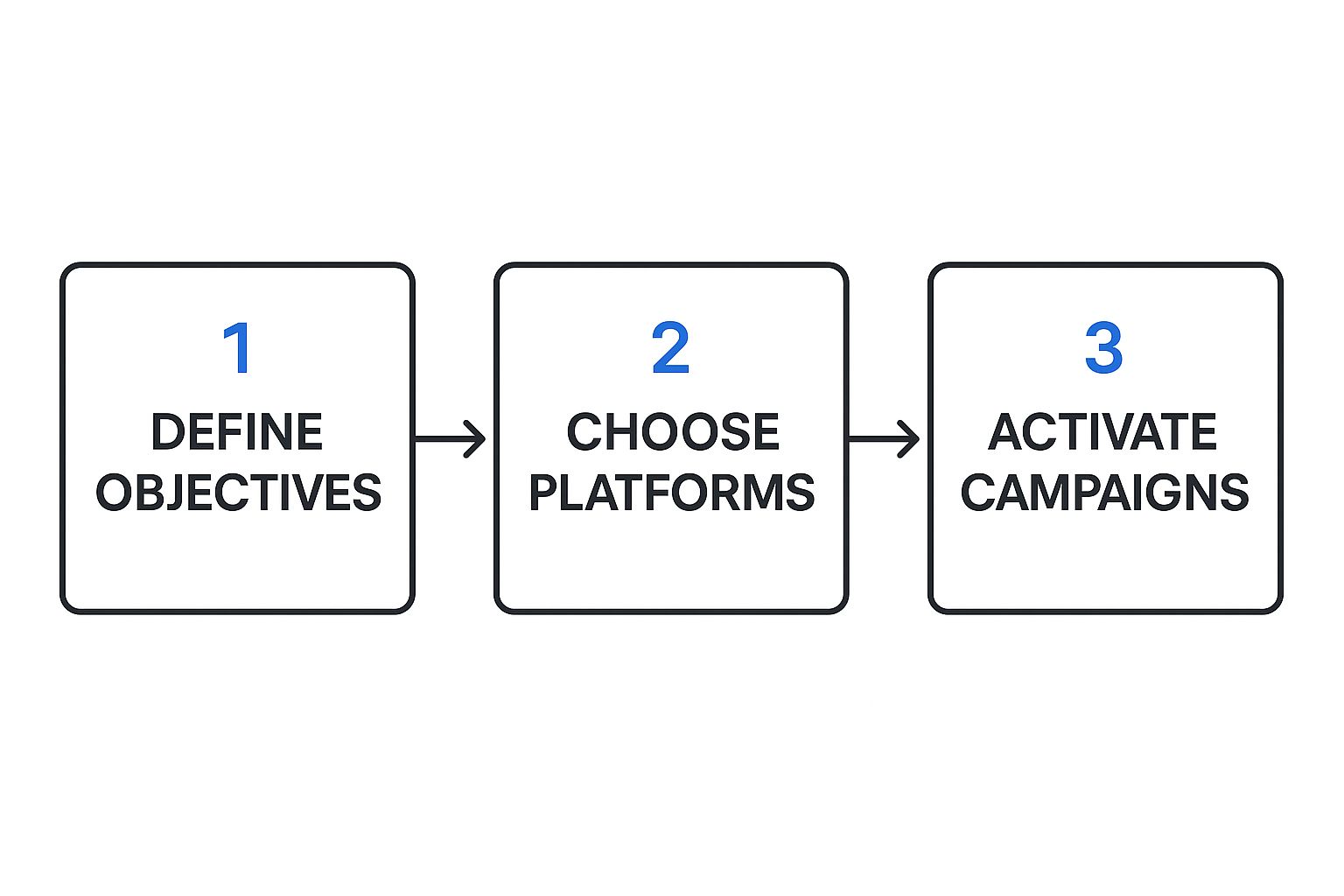
As you can see, activating your campaigns is the final piece of the puzzle, built on the solid foundation of clear goals and the right tech.
To help you get started, I've put together a quick-glance table of some essential workflows. These are the workhorses of marketing automation.
Essential Automation Workflow Examples
| Workflow Type | Common Trigger | Primary Goal |
|---|---|---|
| Welcome Sequence | New email subscription | Onboard new subscribers, build trust |
| Lead Nurturing | Content download (e.g., ebook, guide) | Educate and warm up inbound leads |
| Abandoned Cart | Item left in online shopping cart | Recover potentially lost e-commerce sales |
| Customer Re-engagement | Inactivity for a set period (e.g., 90 days) | Win back disengaged customers or subscribers |
These examples cover the core functions you'll want to automate first. They focus on crucial touchpoints in the customer lifecycle, from the very first interaction to winning back someone who has gone quiet.
The All-Important Welcome Sequence
If you only build one automation, make it this one. Your welcome sequence is your single best chance to make a killer first impression. It confirms that signing up was the right move and sets the tone for your entire relationship.
A single, generic "Thanks for subscribing!" email just isn't going to cut it. A truly effective welcome sequence is a mini-campaign, usually 3-5 emails sent over the first week.
Here’s a proven structure:
- Email 1 (Sent Immediately): Confirm the subscription and deliver whatever you promised them (your lead magnet, a discount code, etc.). This email will have your highest open rates, so make it count.
- Email 2 (Day 2): Share your brand's story or mission. This is your chance to connect on a more human level and show them what you're all about.
- Email 3 (Day 4): Give them your best stuff. Link to a cornerstone blog post, a popular tutorial video, or a super-useful checklist. Prove your value.
- Email 4 (Day 6): Ask a simple question to encourage a reply. Something like, "What's your biggest challenge with [your industry] right now?" This sparks engagement and gives you priceless customer insights.
The goal here is simple: go from being a stranger to a trusted resource in just a few days. That initial positive vibe is what builds long-term loyalty.
Nurturing Your Inbound Leads
Let's be real: not every lead is ready to buy the second they download your ebook. A lead nurturing workflow is designed specifically for these folks-people who've shown interest but aren't quite ready for a sales pitch.
Imagine someone just attended your webinar on "Project Management Tips." That action is the trigger that kicks off the automation.
- First, you'll send an immediate post-webinar follow-up. Thank them for attending and provide a link to the recording and slides. It’s a simple, helpful gesture.
- A few days later, send a link to a related case study. Show them how a company just like theirs found success with your project management software.
- Next, send an email that tackles a common pain point from the webinar. Offer a quick tip or a link to a blog post that digs deeper into the solution.
- Finally, after you've provided all that value, you can introduce a soft call-to-action. Invite them to a personal demo to discuss their specific challenges.
This sequence is about gently guiding prospects, not shoving them toward a sale. It positions you as an expert who is there to help. This kind of targeted content delivery is where automation truly flexes its muscles. In fact, solid personalization can reduce marketing costs by up to 50% and lift revenues by 5-15%.
The Abandoned Cart Recovery Machine
For any e-commerce brand, this workflow is a straight-up revenue machine. With nearly 70% of online shopping carts being abandoned, a timely, automated email series can claw back a huge chunk of that lost income.
A great abandoned cart email isn't a scolding "Come back and buy!" It's a helpful nudge that addresses why they might have hesitated in the first place.
A simple three-part series works wonders:
- Email 1 (1-3 Hours After Abandonment): A friendly, low-pressure reminder. "Did you forget something?" Include a picture of the item and a clear link straight back to their cart.
- Email 2 (24 Hours Later): Remind them why they wanted it. Share the product's top benefits or a glowing customer review to build confidence and overcome indecision.
- Email 3 (48-72 Hours Later): If they still haven't purchased, introduce a little incentive. A small nudge like free shipping or a 10% discount can create enough urgency to seal the deal.
The copy for these emails is obviously critical. For more on that, you can check out our guide on how to automate content creation with AI to get compelling text for your workflows. By building these core automations, you create a system that works 24/7 to nurture your leads and recover sales, setting a powerful foundation for your entire marketing strategy.
How to Measure and Continuously Optimize Your Strategy
One of the biggest mistakes I see marketers make is treating automation as a "set it and forget it" task. They’ll spend weeks building out incredible workflows, flip the switch to turn them on, and then immediately move on to the next shiny object on their to-do list.
That approach leaves so much potential on the table.
Real growth doesn’t come from just launching a strategy; it comes from treating it like a living, breathing system that needs constant care and attention. This ongoing cycle of measuring, tweaking, and optimizing is what separates the good marketers from the truly great ones. It’s all about developing a data-driven mindset where you’re always asking, "How can we make this just a little bit better?"
Over time, those small, incremental improvements snowball into massive performance gains.
Identifying Your Most Important KPIs
Let's be clear: you can't improve what you don't measure. Before you can optimize anything, you need to know which numbers actually matter. It's incredibly easy to get lost in a sea of data, so the trick is to focus on the Key Performance Indicators (KPIs) that truly reflect the health of your marketing automation strategy.
These aren't just vanity stats like how many emails you sent. They tell a story about how people are interacting with your brand and how effective your campaigns really are.
Here are the essential KPIs you should have on your dashboard for any automation workflow:
- Open Rate: This is your first hurdle. It’s the percentage of people who opened your email and a great signal of your subject line's power and your sender's reputation.
- Click-Through Rate (CTR): This tells you how compelling your message is. It’s the percentage of recipients who actually clicked a link in your email.
- Conversion Rate: This is the big one-the ultimate measure of success. It's the percentage of people who completed the goal you set, whether that’s making a purchase, booking a demo, or filling out a form.
- Unsubscribe Rate: A high unsubscribe rate can be an early warning sign that your content is missing the mark or that you're emailing people too often.
By keeping a close eye on these metrics, you create a real-time performance dashboard for your strategy, letting you spot wins and problems at a glance. For a closer look at these numbers, it’s worth understanding why email automation best practices matter for growth.
The Power of A/B Testing
Once you have a baseline for your KPIs, it's time to start making them better. The most reliable and effective way to do this is through consistent A/B testing, also known as split testing. The concept is simple: you create two versions of a single element-like a subject line-show each one to a different part of your audience, and see which one gets better results.
A/B testing is how you move from "I think this will work" to "I know this works because the data proves it." It takes all the guesswork out of optimization.
The golden rule here is to only change one variable at a time. If you test a new subject line and a new CTA in the same email, you'll have no idea which change was responsible for the results. Isolate your tests to get clean, actionable data.
Here are a few high-impact elements I always recommend testing:
- Subject Lines: Try pitting a direct, benefit-driven subject line against one that sparks curiosity. Think "Your Guide to Project Management" vs. "The One Mistake Sabotaging Your Projects."
- Call-to-Action (CTA) Button: Test different copy ("Get Started Free" vs. "Create My Account") or even something as simple as the button's color. You'd be surprised what a difference it can make.
- Email Body Copy: Does your audience prefer long, detailed emails or short, punchy messages that get straight to the point? Test it!
- Timing and Cadence: Experiment with the delay between emails. Does a follow-up after 24 hours perform better than one sent after 48 hours?
Even a tiny lift in a key metric can have a massive ripple effect. A 2% increase in the conversion rate on a high-volume abandoned cart workflow could easily translate into thousands of dollars in recovered revenue over the course of a year.
Analyzing Your Workflow Reports
Beyond individual email stats, you need to zoom out and look at the performance of your entire workflow. Most marketing automation platforms have reports that show you exactly how contacts are moving through your sequences, including-most importantly-where they’re dropping off.
Think of this as a treasure map for optimization.
For instance, you might pull a report on a 5-step welcome series and notice a massive drop-off after email #3. That's a huge red flag waving right at you. When you spot a bottleneck like that, it's time to play detective.
- Is the content in email #3 irrelevant or boring?
- Is the call-to-action confusing?
- Is there a broken link or a technical glitch?
By pinpointing these problem areas, you can focus your energy where it will make the biggest difference. Maybe email #3 needs a complete rewrite, or maybe it just needs a better subject line that more accurately reflects the value inside. This forensic approach turns your strategy from a static plan into a dynamic system that constantly adapts to get better results.
Your Top Automation Strategy Questions, Answered

As you start mapping out your own marketing automation strategy, you're bound to run into some practical questions. It's one thing to understand the high-level concepts, but it's another to figure out the nitty-gritty details. Let's tackle some of the most common questions I hear from marketers who are just getting started.
The first question is almost always about money: what's this actually going to cost? Honestly, the answer varies wildly. Your main expense will be the software subscription, which can be anything from less than $100 per month for a simple tool to thousands for an enterprise-level platform.
But don't forget the other costs. You'll need to budget for potential setup fees, the resources to create your emails and landing pages, and-this is a big one-your team's time for training and day-to-day management. A simple setup might run a few thousand dollars a year, but a comprehensive strategy for a medium-sized business can easily climb into the tens of thousands.
Can Small Businesses Really Benefit from This?
Absolutely. I get this question a lot, and my answer is always a resounding yes. For a small operation, automation is like adding a new team member who works 24/7. It's a massive force multiplier, letting a one or two-person team communicate professionally with hundreds or even thousands of contacts.
Think about the immediate impact of a few simple workflows:
- Welcome Emails: Greet every new subscriber the second they sign up. You make a great first impression and deliver value right away, all without lifting a finger.
- Lead Follow-ups: Someone fills out a form on your site? They immediately get a thank-you email with the resource they requested. No more leads going cold because you were busy.
- Appointment Reminders: Drastically cut down on no-shows for sales calls or appointments with a simple, automated reminder email or text.
Many platforms, like Mailchimp or ActiveCampaign, have affordable plans built specifically for small businesses, so it's more accessible than ever.
The real power of a marketing automation strategy for a small business is its ability to create consistent, professional touchpoints at scale. This frees you up to focus on growing the business, not just managing an inbox.
What's the Difference Between Marketing Automation and a CRM?
This is another common point of confusion. Many people think they're the same thing, but they serve distinct-though complementary-roles. They work best when they're integrated, but here’s how to think about them separately.
| System | Primary Function | Core Focus |
|---|---|---|
| CRM (Customer Relationship Management) | Manages one-to-one relationships and interactions. | Sales and Account Management |
| Marketing Automation | Manages one-to-many communication at scale. | Marketing and Lead Nurturing |
Think of it this way: your marketing automation platform is your top-of-funnel workhorse. It captures new leads and nurtures them with targeted content until they're ready for a sales conversation.
Your CRM (like HubSpot or Salesforce) is where your sales team lives. It’s the system of record for individual customer relationships, deal tracking, and sales activities.
When a lead hits a certain score or takes a key action (like requesting a demo), your automation software passes them seamlessly to the CRM. This handoff is what creates a truly efficient marketing and sales machine.
Write smarter, starting today
Join entrepreneurs and teams who draft, rewrite and ship their content with one AI suite.